Feb 1, 2008
The Great Physician’s Touch Mark 1:21-28
21They went to Capernaum; and when the sabbath came, he entered the synagogue and taught. 22They were astounded at his teaching, for he taught them as one having authority, and not as the scribes. 23Just then there was in their synagogue a man with an unclean spirit, 24and he cried out, “What have you to do with us, Jesus of Nazareth? Have you come to destroy us? I know who you are, the Holy One of God.” 25But Jesus rebuked him, saying, “Be silent, and come out of him!” 26And the unclean spirit, convulsing him and crying with a loud voice, came out of him. 27They were all amazed, and they kept on asking one another, “What is this? A new teaching—with authority! He commands even the unclean spirits, and they obey him.” 28At once his fame began to spread throughout the surrounding region of Galilee.
Now a days, educated and sophisticated people don’t want to talk about things like evil and demons and all that stuff. We are all basically good people, right? It’s all just bad conditions that lead people to do bad things. If we just worked harder to improve things then acts of evil would not happen. Now I appreciate humanistic psychology, and our human capacity to be who God has made us to be. Yet, there are times when we need to be healed by our Great Physican. There are times when we need God to cleanse us from the spiritual poisons and toxins that hinder us from growing as Christians.
Have you ever had a moment where you sensed you encountered someone or something that really seemed evil? Have you ever wanted to have the authority of the priest in the Exorcist movie, and splash holy water on someone, “The power of Christ compels you!” Some of you have seen the documentaries of how the Roman Catholic Church still continues this ritual of purification. Many religions have a similar ritual that gives someone a psychological and spiritual release from the inner demons that are tormenting them.
When I was in seminary I volunteered as a chaplain at San Quentin State Prison. Every week we brought the chapel service to the people living with HIV/AIDs who had to be kept separate from the general prison population. One of the most remarkable encounters I have ever had with the forces of evil came while I was trying to serve communion. There was this scraggly, wild eyed prisoner on the other side of the fence who was determined to do every thing he could disrupt the sacrament. He yelled and screamed and tried to derail the service. I will never forget the looks he gave me. If there was ever a time I wanted to perform an exorcism it was then. He’s lucky I didn’t bring holy water with me that day.
One of the things we need to remember when we wrestle with these questions of good and evil, and the body of Christ’s role in confronting it; is that we too are vulnerable of becoming infected. We need enough humility to go through our own process of being cleansed. Blaise Pascal wrote, “Men never do evil so completely and cheerfully as when they do it from religious conviction.” We should never be so proud and sure of ourselves, that we presume that we do not need to receive a healing touch from the Great Physician.
We have seen the church at it’s worst when it is too sure of itself. In M Scott Peck’s People of the Lie, he warns us that we are on thin ice when we think we are good and all the evil in the world is outside of ourselves. When we have these blinders of denial on, this is when the forces of evil can work on us under the radar.
The Twentieth Century presented us with some challenging questions. Are we basically good as human beings? Students of history and psychology have been debating with the pop-self-help gurus for decades. As Christians, our tradition has kind of a middle of the road position. Yes, we have this notion of original sin. Evil has a stronger hold us, when we don’t have Christ in our life. But in our baptism, this is in some ways an exorcism, where we are cleansed and purified. We are united with Christ, as our new Adam who lifts this burden from us.
When we are baptized we participate in the death and resurrection of our Risen Lord. These cleansing waters enable the Great Physician to enter our lives in a deeper and more complete way. In our Baptism, we have received some of antidote we need against the forces of evil that try to possess our hearts and minds. One of our challenges is not be so puffed up that we think we are immune from evil taking hold in our lives. What’s the old saying, “ Well, Physician heal thyself !” We need to take our medicine if we are to be able to help heal others.
It’s appropriate that the priest performing an exorcism uses holy water. These cleansing waters are instruments of the Great Physician’s touch. What would have happened if a German Catholic priest had the courage to perform an exorcism on Hitler, or a Russian Orthodox Priest to sprinkle holy water on Stalin? Can you imagine how different our world would be today?
There is a remarkable story of two Jewish kids growing up in the Bronx. Philip Zimbardo and Stanley Milgram attended the same kindergarten class. These two boys grew up to be two of the most famous psychologists. It’s poignant that these two Jewish men’s did research that gives us some insight into how something as evil as the holocaust could happen.
Milgrim’s conformity study had people in a lab turning a dial that would shock someone as a form of punishment. The doctor in a white lab coat would tell the subject to keep turning up the dial on the machine to shock this disobedient person in the other room. “It’s for their own good.” The actor would be screaming bloody murder, yet some of the subjects were still willing to turn up the dial.
Zimbardo, Milgrim’s classmate from the Bronx, is well known for his Stanford Prison experiment. He set up a mock prison where college students took on the roles of playing guard and prisoner. Things got so out of hand they had to stop the experiment. Students playing the guards were mistreating the prisoners. If this happens at one of our most prestigious universities with some of our brightest and gifted, what does this say about our common humanity. We need to be humble enough to acknowledge that evil exists in this world and none of us immune from its influence.
Most of our children stories and cartoons have the same overarching theme. The forces of good battling against the forces of evil. As adult we see this all the time in the movies, Star Wars, the Matrix, Batman & Superman. We look for these heroes that give us courage that in the end the forces of evil will be defeated.
In some ways it’s appropriate that we now have a Jesus action figure (minus the kung fu grip). We really don’t need all these super heroes to be inspired and comforted by the hope we have that in Christ, good will finally triumph in the end. When Jesus walked that path to Calvary, and walked out of the empty tomb, Jesus, our Redeemer, conquered evil once and for all.
God’s entire created order was transformed that Easter morning. It’s hard to put words to such an incredible event. When we are baptized, the promise and deliverance of Easter is more fully realized. In these cleansing waters, we are initiated into the body of Christ. Here, the Great Physician is able to administer the vaccine for our souls.
Every Sunday when we pray our confession and assurance of pardon this is a cleansing ritual where our Great Physician can heal us again and again from any emotional or spiritual poison. Like the flu, we will never be fully immune from the evils of this world. But we know whose touch can always deliver us.
The Good News is that we are never beyond the reach of our Great Physician. There is grace and redemption extended to every child of God. We take our own medicine, so we are able to be instruments of God’s healing touch to others. Jesus is always ready and willing. He’s one of the doctors who still makes house calls. Any hour, any distance.
Howard's Sermons and Article Clippings.

About Me
- Howard
- Im a Mainline protestant minister who loves serving in multicultural and urban contexts. I'm very interested in how liberation theology and existential-humanistic psychology are applied to the praxis of pastoral care and counseling. My most profound encounters with God come as we sojourn as brothers and sisters seeking the inbreaking of God's reign, here and now.
Saturday, January 31, 2009

Wednesday, January 28, 2009
Howard's Proposed Dissertation Project Design
San Francisco Theological Seminary
Dissertation Project Design
1. Title: Empowering Clergy as Crisis Counselors in Urban America
Author: Rev. Howard Dotson Advisor: Rev. Dr. Paul Hertig
Context: Rampart Div. of L.A.P.D. & the Eastern District of St Paul P.D.
2.Problem:
In the North American urban ministry context, gang violence is claiming the lives of far too many young people. In the City of Los Angeles there are forty thousand gang members; most of whom were baptized in Latino Catholic and African American Protestant congregations. In the Rampart Division of LAPD (Los Angeles Police Department) it has become evident that many of these grieving families are not receiving immediate pastoral care following a gang related homicide. This is due in part to communication gaps between the Police and the faith communities, but there is also the stigma of being the bereaved parent of a child who is presumed to be a gang member. Like the LAPD, many police departments have clergy councils that could serve as referrals and first responders to provide emotional and spiritual support for these grieving families. Many of the clergy representatives on these councils, however do not have adequate crisis counseling training to serve in this capacity.
3. Purpose:
Improving the communication and response time between the Los Angeles Police Department and the volunteer clergy councils in Los Angeles, CA, where Rev. Dotson worked for 3 years. Such an arrangement of clergy councils will also be assessed with the St. Paul Police Department and the East Side of St. Paul, MN community where he has recently relocated. Rev. Dotson objective is to facilitate the ongoing training with LAPD Clergy Council members and assess the benefits of this model being replicated with the Eastern District of the St Paul Police Dept.
Another objective for this dissertation project is to increase the number of clergy who are equipped with the crisis counseling skills and training necessary to serve bereaved families traumatized by violence in their communities. With this continuing education training, an increased number of clergy will be more effective urban pastoral care providers. They will join a more comprehensive interdisciplinary system working to decrease the psychological and social barriers that hinder the traumatized and grieving families from gaining access to emotional and spiritual resources. These bereaved families need every resource available to them to enhance their coping skills, and thereby minimizing some of common psychological risk factors and vulnerabilities.
4. Scope:
Crisis counseling is a specialized form of pastoral care and counseling that centers around providing emotional and spiritual support to persons who experience a crisis due to a tramautic event that has overwhelmed one’s coping skills. Howard Stone and David Switzer have presented crisis counseling models that are readily applicable to the context of urban pastors providing pastoral care and counseling to bereaved families coping with emotional and spiritual stressors associated with a sudden and traumatic act of violence. The psychological literature demonstrates that there are some common yet unique psychological risk factors that bereaved families encounter as they cope with the loss of a loved one to violence.
In Rev. Dotson’s clinical and pastoral work, these families have frequently presented with vulnerabilities for developing Post Traumatic Stress Disorder, Complicated Grief and an increased risk for suicidality. His master’s degree in psychology prior to seminary and ongoing training with the Dr. James Bugental’s Art of Psychotherapist Institute provides some unique clinical and theoretical insight into how clergy can be trained and equipped to provide pastoral care for grieving and bereaved families.
His clinical orientation as an Existential-Humanistic pastoral counselor specifically focuses on how a pastoral care provider assists someone with their ability to face the givens of their human existence and the existential crisis that this traumatic act of violence presents. One’s own mortality is front and center when one grieves the loss of a loved one. One of the coping resources that can be fostered in these crisis counseling sessions is an exploration of how the bereaved might discover meaning in the midst of their despair and feelings of emptiness. How will they define the legacy of their loved one? How might they invite others to join them in paying tribute to their loved one by working together to assure that another mother will not have to endure the tragedy they are facing ? In Rev. Dotson’s pastoral counseling experiences with dozens of bereaved families, this existential-humanistic coping mechanism has consistently proved effective.
This theological and social framework provides a mechanism for the community stakeholders to engage the families in ways that transcend the all too common condescending modes of sympathy. Many grieving families resent and repel being fussed over by people who have good intentions. The bereaved family members increasingly feel isolated as the well wishers quickly shift and go back to life as normal, while they remain in their grief and bereavement.
When the bereaved families see how the community has come together to memorialize the fallen through commitments to peacemaking and reconciliation, their coping resources will be strengthened. Together they find a common mission that enables them to engage these new friends and colleagues. Bereavement is for a life time. Clergy crisis counselors can help organize these community stakeholders as agents of meaning-making that envelope these bereaved families. This is a long term coping strategy that helps sustain the bereaved over the months and years following the loss of their loved one.
5. Method including data sources and research steps, and the implementation, evaluation, and testing of the project;
Over the past four years, Rev. Dotson has worked with the LAPD and the Mayor’s Crisis Response Team to provide pastoral care and counseling to dozens of grieving families following a gang related homicide in the West LA and Rampart Divisions. The City of Los Angeles and the City Attorney’s have presented him with several commendations for this work.
In his new context on the East side St Paul, the scale and scope of violent crimes is fractional compared to Los Angeles, but the community surrounding Arlington Hills Presbyterian Church (AHP) has the highest crime rate for the entire city. This is a diverse community predominantly comprised of impoverished African American, Latino and Asian at-risk-youth vulnerable to gang recruitment. When Rev. Dotson was hired by the AHP session as Interim minister, the session members endorsed his community outreach to the Police Dept and the ecumenical community.
Rev. Dotson presently serves as a volunteer chaplain with the St Paul Police Dept. Commander Martinez, the Senior Commander for the Eastern District of the St Paul Police Dept. has engaged him to serve as a resource and liaison with the growing Latino community in the district. As collaborative partners, they are actively confronting the stigmatization families experience after a gang-related-homicide. As an extension of the St Paul PD Chaplaincy unit, they partner to ensure that the grieving families receive the emotional and spiritual support they need to cope with the traumatic event and their grief and bereavement.
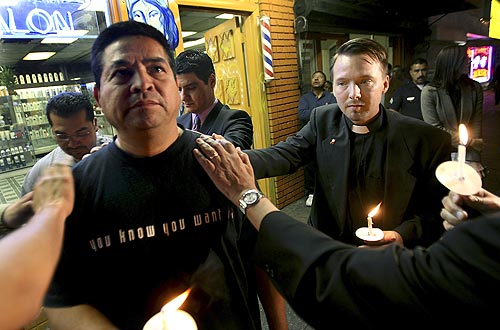
Over the past six months, five candle light vigils have been organized to provide emotional and spiritual support to the bereaved family members and the traumatized community members. This has been well received by the community stake holders in St Paul. Many residents feel powerless and overwhelmed. This liturgical ritual allows the community to come together and provide emotional and spiritual support to the families. After the clergy crisis counselor has provided this ritual, the family is more receptive to the clergy for a follow-up consultation that enables pastoral assessment, crisis counseling and possible referral to appropriate mental health professionals.
The candle light vigils are points of contact with the family members and friends to assess the level of emotional and spiritual resources available to them. If they are affiliated with a particular parish/congregation and have already connected with their primary pastoral care provider, then deference is afforded to this clergy person. More often then not, however, the family has yet to engage their pastor because the funeral is days off.
In the Los Angeles context, if there is a crisis counselor already working with the family, then the pastoral care provider defers to h/her and takes their lead on what the families’ presenting needs are. In the St Paul context, the chaplaincy unit provides the short term crisis counseling at the scene of the crime or at the hospital. Clergy in both contexts will be advised and trained on how to function appropriately within the duties and responsibilities assigned to the various agencies that have been organized to assist the crime victim’s families.
6. Representative Bibliography
Batestone, D. (1993) New Visions of the Americas: Religious Engagement and Social Transformation. Minneapolis: Fortress Press
Bodenhamer, D. (1998) Voices of Faith: Making a Difference in Urban Neighborhoods. Bloomington, IN: Indiana University Press.
*Bugental, JFT. (1965) The Search for Authenticity: An Existential-Analytic Approach to Psychotherapy. New York Holt Rhinehart & Winston
Corr,C. & Balk,D. (2004) Handbook of Adolescent Death and Bereavement. NY:Springer.
Claerbaut, D.( 2005) Urban Ministry in a New Millenium. London: Authentic Media.
Culbertson, P. (2000) Caring for God’s People: Counseling for Christian Wholeness.
Minneapolis: Fortress Press.
Delgado,G. (1994) Beyond the Politics of Place: New Directions in Community Organizing in the 1990s. Oakland, CA: Applied Research Ctr.
Doyle, P. (1980) Grief Counseling and Sudden Death: A Manual and Guide. Springfield, IL: Charles C. Thomas
Dolendorf, D. (1999) Post Traumatic Stress Disoder. Gale Encyclopedia of Medicine.
Guder & Barret. (1998) The Ministry of the Missional Church: A Vision for the
Sending of the Church in North America. Grand Rapids, MI: Eerdmans.
Lawrenz & Green (1996) Overcoming Grief and Trauma. Grand Rapids, MI. Fleming H. Revell.
*May, R. (1950) The Meaning of Anxiety. New York: WW Norton.
Humprhey, G & Zimpfer, D. (1996) Counseling for Grief and Bereavement. London: Sage.
Pattison, S. (1994) Liberation Theology and Pastoral Care. Cambridge, UK: Cambridge Press.
Oates, W. (1997) Grief, Transition and Loss: A Pastor’s Practical Guide. Minneapolis: Fortress Press.
Peters R. (2007) An Introduction to Urban Ministry. Nashville: Abingdon
Rogers-Fuller, D. (2002) Pastoral Care for Post Traumatic Stress Disorder. Philadelphia: Haworth Press.
Rosenthal & Mizrahi (1994) Strategic Partnerships: How to Create & Maintain Interorganizational Collaborations & Coalitions. New York: Hunter College School of Social Work
Schoenberg, B.M.(1980) Bereavement Counseling: A Multidisciplinary Handbook. Wesport, CT:Greenwood Press.
Shapiro, E. (1999) Grief as Family Process: The Circumstances of the Death and the Structure of Grief. Guilford, NY
Stone, B. (1996) Compassionate Ministry: Theological Foundations. New York:Orbis
*Stone, H (1993) Crisis Counseling. Rev. ed. Minneapolis: Fortress Press.
*Stone, H (1994) Brief Pastoral Counseling. Minneapolis:Fortress Press.
Stone, H (2001) Brief Pastoral Counseling: Short Term Approaches and Strategies. Minneapolis: Fortress Press.
* Switzer, D (1986) The Minister as Crisis Counselor. Minneapolis: Fortress Press:
* Switzer, D (2000) Pastoral Care Emergencies. Minneapolis: Fortress Press.
Van Gelder, C.(2007) The Ministry of the Missional Church. Grand Rapids, MI:Baker Books.
Wicks, Parsons & Capps (1993) Clinical Handbook of Pastoral Counseling. V. 1& 3 New York: Paulist Press.
7. Contributions which you expect the work to make to the practice of ministry in the contemporary world;
This training model of empowering clergy as crisis counselors will enhance an urban pastor’s ability to partner with local law enforcement personnel and city officials to confront the psychological and sociological barriers that hinder families from receiving critical emotional and spiritual resources. Urban pastors are called to be prophetic social change agents who confront some of the deleterious social patterns that too frequently blame the victims.
The bereaved families need the broader community to surround them with love, compassion and spiritual support. How will we make meaning out of this? How can we discover hope in the midst of this tragedy and despair? Finding a constructive answer to this pervasive existential question is a critical coping resource that helps decrease the bereaved person’s vulnerabilities for further psychological problems as they continue their difficult journey. Urban pastors serving as crisis counselors need to posses some specific knowledge and skills set to provide emotional and spiritual support to these bereaved families and to engage the proper referral mechanisms, when and if it is warranted.
8. The time schedule you expect to follow;
Feb 24 2009
• Clergy consultation with Rampart Clergy Council
• Compile course evaluations
April 2009
• Present findings to Commander Martinez and the St Paul Chaplaincy Unit
• Assess the feasibility of replicating this model
with St Paul clergy serving the Eastside of St Paul
• Arrange a clergy consultation with Latino clergy in
the Eastern District of St Paul PD to address the stigma and isolation that bereaved families frequently endure after a traumatic act of violence.
May 2009
Continued research, pastoral praxis and the production of the dissertation.
Saturday, January 24, 2009
A Broken System: Sojourners Magazine
For the first time in history, according to a recent study by the Pew Center on the States, more than one in every 100 adults in the U.S. is in jail or prison. There has not been, however, a correlating decrease in crime. “The education system, particularly for inner-city youth where the bulk of our prisoners come from, is abysmal,” Carol Fennelly, executive director of Hope House, a Washington, D.C.-based organization supporting prisoners’ families, told Sojourners. “We need real job opportunities and a reformed society in which people don’t end up in prison in the first place.” Here are some numbers:
67 percent: People released from prison who are re-arrested within three years.
32 percent: Increase in federal prisoners between 2000 and 2007, which coincides with the 454 new offenses added to the federal criminal code during that same period.
7.4 million. Number of people under the control of the U.S. criminal justice system in 2007.
83.5 percent: People in jail in 2002 who earned less than $2,000 per month prior to arrest.
64 percent: Increase in criminal justice-related government spending between 1996 and 2005, reaching a height of $213 billion in 2005.
Sources: “Moving Target: A Decade of Resistance to the Prison Industrial Complex” (Justice Policy Institute, September 2008); “One in 100: Behind Bars in America 2008” (The Pew Center on the States); The Washington Post.
Children of Abraham United As Peacemakers
Isaiah 2:2-4
The word that Isaiah son of Amoz saw concerning Judah and Jerusalem. 2In days to come the mountain of the Lord’s house shall be established as the highest of the mountains, and shall be raised above the hills; all the nations shall stream to it. 3Many peoples shall come and say, “Come, let us go up to the mountain of the Lord, to the house of the God of Jacob; that he may teach us his ways and that we may walk in his paths.” For out of Zion shall go forth instruction, and the word of the Lord from Jerusalem. 4He shall judge between the nations, and shall arbitrate for many peoples; they shall beat their swords into plowshares, and their spears into pruning hooks; nation shall not lift up sword against nation, neither shall they learn war any more.
Luke 22:47-53
47While he was still speaking, suddenly a crowd came, and the one called Judas, one of the twelve, was leading them. He approached Jesus to kiss him; 48but Jesus said to him, “Judas, is it with a kiss that you are betraying the Son of Man?” 49When those who were around him saw what was coming, they asked, “Lord, should we strike with the sword?” 50Then one of them struck the slave of the high priest and cut off his right ear. 51But Jesus said, “No more of this!” And he touched his ear and healed him. 52Then Jesus said to the chief priests, the officers of the temple police, and the elders who had come for him, “Have you come out with swords and clubs as if I were a bandit? 53When I was with you day after day in the temple, you did not lay hands on me. But this is your hour, and the power of darkness!”
Many times, with candles burning and hearts warmed by family and friends gathered to comfort one another, we have read these passages at candle vigils for peace on the Eastside and Los Aneleges. In these scriptures, our prayers and songs; we remember God’s enduring vision of a world where there are no more tears. One day there will be no more mothers bearing a broken heart because she has lost her precious child to violence.
Today, Dr Reiter will share with us a beacon of hope from the Holy land. In at least two places in the Holy Land, Jews and Muslims can cooperate and accommodate one another’s need to worship and praise God. In our interfaith dialogues, we discover this eternal truth. As children of Abraham; Jews, Muslims and Christians alike, are called to be peacemakers. Father Abraham and the cloud of witnesses that have gone before us are waiting and hoping us to realize greater peace and reconciliation here on the Eastside and across distant shores in the Holy Land.
Now I’m not naive to presume that soon and very soon, we will create a utopia through our bent knees and strained backs. Like Reihnold Neibuhr, we recognize a realism that there is evil in this world that from time to time we have to confront. Nonetheless, we pray and work for that day when the swords and spears are transformed into instruments that bring us our daily bread instead of daily headlines, “if it bleeds it leads.” As the children of Abraham, we work for this vision of a Wew Jerusalem to come into reality, but our human efforts alone will never make things complete. The Spiritual descendants of Abraham join hearts and hands to grow closer and closer to this vision of what God has created us to be. As fellow instruments of peace, who see our neighbours near and far as precious and fragile jar of clay carrying the image and destiny of our Creator.
One of things that I continue to press when people question if these tragic losses are God’s will. These bullets, missiles and bombs that bring far too many broken hearts are not part of God’s will. The violence here on the Eastside of St Paul, in the streets of Gaza and Southern Israel are not part of God’s plan. We remember the call of Isaiah and how Jesus lived the final days of his ministry. When Jesus was most tempted to resort to violence he kept the cup that was set for him and healed the temple guards ear. For two thousand years, Jesus’ words transcends the chapters of history. “No more of this!” Those who live by the sword shall die by the sword.
Our ancestors have endured many oppressive nights. In spite of the hate and rage, we must transcend these poisonous temptations and embrace our higher and truer natures. Jesus reminds us in his Sermon on the Mount the difficult but necessary work of forgiveness and loving our enemies. An eye for an eye and a tooth for a tooth". But I say to you, do not resist an evildoer. If anyone strikes you on the right cheek, turn to him the other also. (Matthew 5:38–39. “If we practice an eye for an eye and tooth for tooth, we will all be blind and tootheless.”
For too long we have allowed the thirst for revenge to shape our sense of what justice is. We pick and choose from the sacred texts to justify our tit for tat understanding of justice. We don’t wont to swallow the hard and bitter truth that if we are ever to see this new Jerusalem in our lives we must forgive and turn the other cheek. At some point, the madness of this back and forth has to stop. Our hearts and minds must experience the touch of God’s healing Spirit that enables us to forgive and forego our thirst for revenge. Are we willing lay our lives and let go of our temporary and fleeting sense of satisfaction? When will we finally accept that this emptiness will remain long after we our futile attempt to achieve closure through revenge? Its only God’s healing touch and the promise of God’s liberating Spirit that will enable all the Children of Abraham to be united in our common calling to be peacemakers.
May the swords and spears become instruments of food security. May the wounds we have afflicted one another be healed by God’s healing touch. Not only the wounds that bleed, but the scars deep within our hearts and minds that hinder our ability to join hearts and hands as the stars in the sky that God promised to Abraham long ago. May these lights of the new Jerusalem shine brighter and truer, this very hour and forever.
Tuesday, January 20, 2009
Sermon: Keep Looking for the Angels John 1:43-51
Keep Looking for the Angels
John 1:43-51
43The next day Jesus decided to go to Galilee. He found Philip and said to him, “Follow me.” 44Now Philip was from Bethsaida, the city of Andrew and Peter. 45Philip found Nathanael and said to him, “We have found him about whom Moses in the law and also the prophets wrote, Jesus son of Joseph from Nazareth.” 46Nathanael said to him, “Can anything good come out of Nazareth?” Philip said to him, “Come and see.” 47When Jesus saw Nathanael coming toward him, he said of him, “Here is truly an Israelite in whom there is no deceit!” 48Nathanael asked him, “Where did you get to know me?” Jesus answered, “I saw you under the fig tree before Philip called you.” 49Nathanael replied, “Rabbi, you are the Son of God! You are the King of Israel!” 50Jesus answered, “Do you believe because I told you that I saw you under the fig tree? You will see greater things than these.” 51And he said to him, “Very truly, I tell you, you will see heaven opened and the angels of God ascending and descending upon the Son of Man.”
Tommorow across our nation people will gather to remember the life and ministry of Dr. King. As a denomination, thousands of our congregations will be observing race relations Sunday today. Presbyterians were very active in the Civil Rights Movement. My mentor in seminary led a busload of seminarians to work in Selma. This is part of heritage that we remember as a nation remembers Dr. King’s dream. We have made huge strides but the dream is still not fully realized. As Christ’s disciples, we continue to dream and seek out the angels. These angels of love and forgiveness lead us in the difficult but necessary work of reconciliation among God’s children.
We are a people who have struggled to keep our practices in line with our principles. Our forefathers fought to lift the yoke of colonial oppression, but the rights of native Americans, Africans and women were not on their radar. I am not shaming or bashing America. I want to see her light shine bright on the hill.
When the Mayflower set sail from Holland they had a vision of this new promised land where followers of Calvin could shape a new order. That first winter was brutal. Half of the pilgrims perished. It was the native Americans who were angels that came to their aid and gave them food. When the ground thawed the Native Americans coached the pilgrims on the native plants that would thrive in this new land. Let’s keep looking for the angels that God sends us today.
Like Thanksgiving, tomorrow is a day when we remember where we came from and discern where we are going. We have a painful history but we also have an awesome story of growing into a more just society. The Hebrew prophets and Jesus’ life and ministry have been the conscience of our nation. When we find ourselves off track we look to this book for guidance. We are kept honest by the eternal truth the Holy Spirit shines in our hearts and minds.
In our gospel lesson we see some of Jesus’ first followers joining his ranks. Even the Son of Man, had to face some prejudice. Nathaniel is credulous. He asks with derision, “ Can anything good come out of Nazareth?” Use your imagination, if you were a minority in America, how do you think this passage would come across to you? Do you think some folks find comfort knowing that Jesus too faced prejudice in his public ministry? Jesus faced a tough crowd and his poor, rural roots defied many of his peoples expectations.
In our second reading, Jesus has to show his power and insight to convince Nathaniel that he is the promised one sent by God. So what if Jesus does not exactly come from the area where some of the prophecies predicted. God is God, and we are mere mortals. If God chooses to adjust the game plan, we are mere water boys on the sidelines. You will see in Matthew’s nativity how careful he is to line up Jesus’ childhood with the historical sites associated with the promised messiah. We can see some of these differing concerns that each gospel writer has. What is critical for Matthew, is not an issue for John. So when it exactly did Nathaniel see the angels descending and ascending upon the son of Man? Was this at the transfiguration? Did this take place in the upper room when Jesus returned to them after the empty tomb?
Ever since the Temple was destroyed in 70AD, the holy of holies is no longer a building. The church of Jesus Christ is made up of the hearts and hands who gather in the name of Jesus. The church is present wherever two or three are gathered. John Calvin wrote in his institutes that each of us are temples of the Holy Spirit. We carry the light and salt within us wherever we go. Every place is sacred where two or more have together proclaim the Gospel of our Lord.
Whenever we are about the ministry of peace and reconciliation the angels of heaven come to attend us. Yes, this world has a cruel history, but for every painful chapter there has been a gathering of faith disciples who carry the Holy Spirit within them. Someone once said, that we help set the thermostat of our society. When things get cold and frozen, God sets a fire in us to dethaw the frigid hearts that refuse to extend the love of Christ.
I am not a life long Presbyterian. I grew up Nazarene in the north-west suburbs. As I have mentioned before, I struggled in this church. I felt our perspective was to narrow. The social gospel emphasis on peace and reconciliation was ridiculed. They only wanted to focus on winning people souls and disregarded any of the social ills plague the least among us. I could no longer be part of a fellowship that allowed racism and prejudice to go unchecked.
After I left the U of M, I went to New York to work in a private psychiatric hospital. I attended worship with one of the physicians who happened to be a Presbyterian. I like to joke that it was predestined that I became Presbyterian. The very first Presbyterian sermon I heard, the pastor used an illustration of serving as Freedom Rider in Selma. I knew then, that I found a home where my hunger for peace and reconciliation could be fed.
We are not mere social activists. In today’s officer's class, we will study the PC(USA) list of the Great Ends of the Church. One of the key points is the promotion of social righteousness. As people of faith, we must not shy away from our calling to be prophetic voices. It’s not always comfortable, but we must stoke a holy dissatisfaction for this gap between the conditions of our world, and the New Jerusalem we are called to help create through the Holy Spirit.
God’s angels are ascending and descending with every social movement that works to preserve the rights and dignity of God’s children. In every chapter of history, we can find a remnant that walked their own Via Dela Rosa to be faithful to Christ’s calling. We need to prepare ourselves for what the world throws at us when we shine the light of Christ through our lives.
Even when we are unpopular and hated for being faithful to the Gospel of Jesus Christ, we walk on. Dr. King knew for a long time that the path he was walking could lead to his own Calvary. The night before that tragic day in Memphis, Dr King assured the congregation. “I’m not worried I have seen the promised land. My eyes I have seen the glory of the coming of Lord.” In Dr. King’s dream do you think these angels were coming and going to tend to the people who would carry the mantel for him after he was gone? Dr. King gave his life so our nation could be transformed into the dream that has become our dream as a nation.
Now I understand that not many of us have the courage of a Dr King or Ganhdi. We won’t be called to lay down our lives for our friends. Nonetheless, every follow of Christ is called to extend sacrificial love to others. Yes, we are brother’s keeper. This is a key part of growth in spiritual maturity. To get out ourselves, and pour our lives into something that is bigger than any one of us.
Without the Angels above and beside us, we lose perspective on what God has placed us here to do. When we feel that hunger in our bones. When a chill goes down our spine, and we feel a heart connection with one of God’s children on the other side of a social divide, an angel has visited us. When we sense the Holy Spirit moving in us and through others, let’s be awake to the dream that is working become a reality.
Our nation is preparing for remarkable chapter in our history. May Dr. King’s dream continue to unfold as a fuller reality. There is still a lot of work to be done. God never promised this would be easy. Keep looking for the Angels who will come to help carry this yoke we carry. We may grow tired and weary but God’s eternal Spirit will come again to sustain us.
Tomorrow may our hearts and minds be renewed with hope and a renewed resolve to love all of God’s children. We don’t see a race, gender or a class of people. Whether we are from Nazareth, West Africa, Norway or Sweden, we are all part of God’s family. May God’s Spirit clear anything from us that keeps us from seeing the wonder and beauty of God’s creation in all peoples.
Lola Michaud's Funeral Meditation
Lola Michaud’s Funeral Service Jan 17, 2008
God's Love Endures Forever Romans 8: 35, 37-39
Who will separate us from the love of Christ? Will hardship, or distress, or persecution, or famine, or nakedness, or peril, or sword? ....” 37No, in all these things we are more than conquerors through him who loved us. 38For I am convinced that neither death, nor life, nor angels, nor rulers, nor things present, nor things to come, nor powers, 39nor height, nor depth, nor anything else in all creation, will be able to separate us from the love of God in Christ Jesus our Lord.
Jan, Sharon and Debbie our thoughts and prayers are with your family as you place your mom to rest. We hope that our gestures of love and compassion help lift the yoke you bear. We will do our best to just be with you and not say things because we don’t know what to say. Like our Good Shepherd, we are here to walk with so you don’t feel isolated in your pain. This journey of grief and bereavement is longer than many of us ever anticipate. Life will not just go back to normal in a few weeks. As a congregation, as family and friends, we walk with you all the way.
One of my favourite lines from the movies is, “We say never say goodbye, only see you later.” As Christians we understand that when we received the waters from this font, we participated in the death and resurrection of our Lord Jesus Christ. We were born again in these waters of Jordan, so death no longer has a hold on us. Jesus has signed, sealed and delivered our passport to eternity. Paul wrote, “Death where is thy victory, where is thy sting.” Yes, we grieve but these tears in the context of knowing where we are going when we Passover into the New Jerusalem. It’s not goodbye, its see you later. No more tears, no more pain. Celestial choirs, placid lakes and all of our friends and loved ones waiting with our Good Shepherd to embrace us again.
When Paul wrote this letter to the church in Rome he was ending his
ministry.Paul knew what was in store for him. His colleagues warned him not to go to Jerusalem but he kept on, knowing the risks he would face. The very people Paul once led, are now after him to silence his voice and the truth he could not help but shout from the roof tops.
Paul knows something about death. He oversaw the group that killed Stephen, our first Christian martyr. It can be hard for us 2000 years later to appreciate the hardships that our ancestors went through before we became the official religion of Rome. Paul is writing to a people who face the very real threat of losing their life for their faith. Paul is being pastoral to a community very anxious about their own mortality. They are human, having second thoughts and doubts are part of our humanity.
It’s in this context that Paul reminds us that God is good, and God is faithful. God came to us in Bethlehem and liberated us once and for all on Calvary. This storm is over. We never have to wonder if God will follow through. When we read God’s holy Word we see how God has kept his covenants with Noah, Abraham, David and now with Jesus our Redeemer.
If there was any question of whether God will follow through Jesus’ departure from the empty tomb and reappearance in the Upper room helps us resolve any doubts.
Lola and Jim are together again. They are watching over their family and friends. Like that scene in Our Town, they are looking back over their lives and seeing more of what life is really about. There are so many opportunities that are before us. Take the time to be with one another. Lola and Jim are with the cloud of witnesses’ nudging us to remember our baptism and trust that God will follow through on his promise when our times come to join them.
Lola came into this world when cars were starting to fill the streets. She was only six years old when the depression hit. The family gathered around the radio to listen to FDR give fireside chats. A reassuring voice in anxious and difficult times. She was part of the greatest generation who led our nation through the war to end all wars. Lola and her generation can teach us something about how we can of triumph over adversities.
We live in anxious times. Yet we walk on with hope and assurances because we know who holds the future, and who holds us in eternal love.
One of the things that stood out for me when I heard some of Lola’s life review was that she was Lutheran and Jim was Catholic. I guess being Presbyterian was the goldie-locks option right in the middle. AHP's first campus on Edgerton was just a block away from where they raised their girls.
When Lola and Jim chose AHP they wanted to be part of a neighbourhood church. These denominational differences did not matter so much. Jim made sure that the girls got to church on Sunday. Lola and Jim have modeled for us the unity that we are called to live out as humble servants in Christ’s body. We are all parts of one body. Branches leading out from the one true vine.
No matter where we started, we come together to appreciate all that we have in common. AHP continues to be a neighbourhood church that embraces folks from many backgrounds. I have a hunch that Lola and Jim were part of the building of this come as you are hospitality. No one has all the right answers. We just want our children to grow and learn how to love their God and their neighbors as themselves. We come together to learn how to love one another as God loves us. We will never reach the top but we keep our compass aligned with how Jesus lived and what he continues to teach us.
Brothers and sisters this is the Good News. God’s promise to us will never fail. God’s love will hold us forever. The Good Shepherd will never abandon his sheep. Lola has passed through her darkest valley and the Shepherd has carried her through to calmer waters and green pastures.
Her life and legacy lives on in you. Tell each other the stories about Lola. I bet there are new things you will learn about her. Remember her for the entire life she lived. Well done good and faithful servant. Be at peace.
Flyer for Feb 24th 2-5 Rampart Station of LAPD
Empowering Clergy as Crisis Counselors
Tues. Feb 24th 2-5 PM
Many of our community stakeholders look to their faith community leaders for emotional and spiritual support when tragedy strikes. Far too many Angelenos have endured the hardships of losing a loved one to gang violence without adequate emotional and spiritual support.
There is a significant gap between the average clergy person’s counseling training and the common perceptions and expectations in our communities. Most seminarians only receive one course in pastoral care and counseling. Crisis Counseling skills and the common risks factors associated with traumatic acts of violence are not usually in the curriculum. Several psychologists on staff with the LAPD will lead workshops on:
• PTSD
• Complicated Grief
• Assessing for Suicide risk
As urban pastors, we need continuing education if we are to serve as effective pastoral counseling resources for the LAPD clergy councils. By attending this consultation and remaining active in your local LAPD Clergy Council, you will be part of a growing community of faith leaders working together for peace and reconciliation in Los Angeles.
Rampart Clergy Council
Community Room at the Rampart Community Police Station
1401 W 6th St LA, CA 90017
Parking is available across the street on 6th St.
RSVP with Rev. Howard Dotson
hr_dotson@yahoo.com (612) 702-3151
Subscribe to:
Posts (Atom)

 Posts