Bearing Compassion for the Lepers of our Day April 1, 2009
Isaiah 61:1-4
The spirit of the Lord God is upon me, because the Lord has anointed me; he has sent me to bring good news to the oppressed, to bind up the brokenhearted, to proclaim liberty to the captives, and release to the prisoners; 2to proclaim the year of the Lord’s favor, and the day of vengeance of our God; to comfort all who mourn; 3to provide for those who mourn in Zion— to give them a garland instead of ashes, the oil of gladness instead of mourning, the mantle of praise instead of a faint spirit. They will be called oaks of righteousness, the planting of the Lord, to display his glory. 4They shall build up the ancient ruins, they shall raise up the former devastations; they
John 10:1-11
Very truly, I tell you, anyone who does not enter the sheepfold by the gate but climbs in by another way is a thief and a bandit. 2The one who enters by the gate is the shepherd of the sheep. 3The gatekeeper opens the gate for him, and the sheep hear his voice. He calls his own sheep by name and leads them out. 4When he has brought out all his own, he goes ahead of them, and the sheep follow him because they know his voice. 5They will not follow a stranger, but they will run from him because they do not know the voice of strangers.” 6Jesus used this figure of speech with them, but they did not understand what he was saying to them. 7So again Jesus said to them, “Very truly, I tell you, I am the gate for the sheep. 8All who came before me are thieves and bandits; but the sheep did not listen to them. 9I am the gate. Whoever enters by me will be saved, and will come in and go out and find pasture. 10The thief comes only to steal and kill and destroy. I came that they may have life, and have it abundantly. I am the good shepherd. The good shepherd lays down his life for the sheep.
Today we reflect on the last of the Lenten passages before we enter Holy Week. Jesus’ public ministry is coming to an end. The showdown in Jerusalem and the garden of Gethsemane is upon us. Can you feel the suspense and how high the stakes are? These three years of public ministry are coming to the end, will the center hold? Can the disciples stay awake and stay faithful after their shepherd is taken from them. Will the sheep scatter and scurry? Will they ever find their way back to the fold?
We will be looking at another MDG (Millennium Development Goal) set by our world leaders at the UN. To halve the number of people living with HIV/AIDS but still do not have access to the essential medicines. The lepers of our day are not only people with HIV, but also our brothers and sisters living with TB and Malaria. The term often used is for this trinity of tragedies is “Diseases of Poverty.” Our UN leaders in New York and Geneva have joined the church in our sacred calling to work for an abundant life to be known by all of God’s children.
Yes, we are our brother’s and sisters’ keeper. Any time a fellow child of God dies of a disease because of poverty this abundant life has been denied to them. Who are the thieves and robbers climbing over the fence to scatter God’s flock? What are the ways and means of the power and principalities of this world that deny our brothers and sisters the abundant life Christ call us to live into being? We must release the drug patents and fully fund the public health ministries so these living saving medicines are accessible to the billions of people who live on one and two dollars a day.
Several years ago in Accra, Ghana I attended the World Alliance of Reformed Churches gathering. Worldwide, there are 74 million Christians who trace their heritage to Calvin’s Reformed tradition. I saw a beautiful tapestry of God’s humanity. Several days in Accra reinforced the reality that the Church of Jesus Christ is growing in leaps and bounds in Asia, Africa and Latin America. In many respects, the face and voice of Christ’s church will be transformed by this new day that is dawning. Will North American and European Christians be open to this new reality? Are we ready and willing to listen to how the Holy Spirit is speaking through our brothers and sisters in the Southern Hemisphere? God’s Spirit will blow where it will. Will we flow with it and soar like an eagle or will be like a stubborn salmon working against the current?
Access to medicine for people living HIV/AIDS is one of the issues where we need to open hearts to the testimonies of our brothers and sisters. All of God’s children should have abundant access to HIV prevention and treatment services. Our Good Shepherd calls us to love our fellow sheep. “If you love me you will feed my sheep.” As Jesus said, "there are sheep of many folds", but we all one have one Good Shepherd, who calls us to our common calling to help secure the abundant life for all of God’s sheep.
This was the theme for WARC conference “I have come that they may have life, and have it in abundance.” HIV/AIDS and the diseases of poverty were critical points of concern. Here in America, the issue of HIV/AIDS has become passé. We are complacent because we think the crisis is over. Isn’t this just a chronic illness now? “Just take your pill and life will go on.” We think we are off the hook of having consciences pricked because of President Bush’s emergency plan. Yes, we have made some progress, but we are far from that marker or mile stone that would justify a reduction of our sense of urgency.
People living with HIV/AIDS, TB and Malaria are the lepers of our day. We remember Jesus’ healing ministry and the powers bestowed upon his disciples to heal and cure the sick. Embracing the lepers and restoring them to a more abundant life is at the core of our mission. We look back to another era when our churches sent out doctors and nurses to the four corners of the world. Some of the fruit we see blossoming in the global church comes from these historic mission hospitals and schools our ancestors in the faith established.
We can’t be satisfied with a token representation of the people we canonize. A few Mother Theresas are not enough for the millions of our brothers and sisters in Africa, Asia and yes here in North America who continue to die from HIV/AIDS. This crisis of humanity is far from over. The media cycle has runs its course, and they have moved on to the next “If it Bleeds it Leads Story.” As disciples of the Good Shepherd, we must keep our eyes and ear’s open to all the sheep of Christ’s fold. We need to remain connected to the Christ’s global church and commune with them in their struggle to bring abundant life to their communities ravaged by the scourge of AIDS.
We need to open our eyes to the new face of AIDS. Here in North America, the leading cause of death for African American women is HIV/AIDS. Many folks in our pews think of AIDS as primarily a concern for the gay community and Africa. Last fall, the CDC acknowledged that they had underreported the infection rates in North America by forty percent. Last Month, the CDC reported that the infection rate in our Nation’s capital has reached 3 % of the population. In America, the land of milk and honey, we have a community with an infection that is eqaul to many countries in sub-Saharan Africa. The face of AIDS has changed. Will we open our eyes to this new reality and respond accordingly?
The face of AIDS has changed, do we see it? African American and Latino American women are part of the new face of AIDS. Will we rise up and speak out for an abundant life for all of God’s sheep? Our Black and Brown sisters are bearing the burden of this enduring tragedy. Will we love and embrace them with compassion? Why do they not receive adequate prevention services? Why are they struggling to secure the essential medicines they need? Why are so many of our sisters living in silence and isolation because of the stigma that still exists?
We are not sent out from the shelter of the flock to judge others who have contracted HIV. It’s irrelevant how the virus entered their body, what matters most is how we love our fellow sheep enduring the modern day leprosy. We are not sent out to judge or condemn. There is only one Good Shepherd. We are merely fellow sheep. We are called to love all of God’s sheep and ensure they can find life in abundance.
Last week I saw the musical Rent at the Orpheum in Minneapolis. If you have seen the play or movie, you will have a sense of what my first encounter was like with someone living with HIV. My senior year in college I moved to NYC and worked in a private psychiatric hospital. I helped counsel heroin addicts in recovery from their addiction. Many IV drug users contract HIV because they share needles.
One day, I saw first hand the stigma and discrimination that people with HIV endure. One of my nurse colleagues was not discrete about his HIV status, and I saw how the other clients on the unit shunned this fellow child of God. For several weeks, I walked with my brother as he went from doctor to doctor learning how low his CD 4 count was dropping. Soon the cancer would come, soon pneumonia would take its hold. He is no longer with us. But his story is seared in my heart and mind.
There is a scene in Rent when Roger, Angel and Tom join a HIV support group. When I hear this song, tears flow for my brother lost long ago:
“Will I lose my dignity, will someone care, will I wake tomorrow from this nightmare. (4x)
My journey with HIV positive IV drug users was a conversion experience. Deep in my bones, I know that no child of God should have to go through this. We must love and embrace all of God’s sheep. We must do everything in our power to secure and preserve abundant life for all. This means everyone should access to healthcare. This is a basic human right. Anyone working to deny this to a fellow child of God is a thief and bandit trying to climb over the fence. The Good Shepherd has a large hook and in God’s time, God’s judgment will be known. Did you love my sheep? Or did you rob them of the abundant life they were entitled to?
Our Good Shepherd stands at the gate. Jesus is calling us on our greed and complacency. How is that we can put a man on the moon, and rovers on mars, but we still cannot provide prevention and treatment services for people living with diseases of poverty?
In Luke’s gospel, when Jesus began his ministry he opened the scroll to Isaiah 61
“The spirit of the Lord God is upon me, because the Lord has anointed me; he has sent me to bring good news to the oppressed, to bind up the broken-hearted, to proclaim liberty to the captives, and release to the prisoners; 2to proclaim the year of the Lord’s favor, and the day of vengeance of our God; to comfort all who mourn.”
Our brothers and sisters living with the leprosy of our day need to the know the year of the Lord has come! They need to be released from their captivity! Yes, we will do all we can to love our fellow sheep and to help secure an abundant life for them. Jesus, we will show our love for you, by loving your sheep, near and far. We will confront the thieves and bandits who would try to climb in over the fence and deny our brothers and sisters their access to life saving medicines. As faith partners, we will do our part to achieve the UN MDG of halving the number of people who do not access to these life saving anti-retroviral medicines.
We will not just stop there. We will proclaim your reign of peace and wholeness until the day you come again to bring us all into your great banquet. May we all sit together with you and hear those precious words, “Well done good and faithful servant. You have loved and fed my sheep.” Our Good Shepherd stands at the gate. Through our hearts and hands, may the Holy Spirit use us to bring abundant life to the lepers of our day, our brothers living with HIV/AIDS.
Howard's Sermons and Article Clippings.

About Me

- Howard
- Im a Mainline protestant minister who loves serving in multicultural and urban contexts. I'm very interested in how liberation theology and existential-humanistic psychology are applied to the praxis of pastoral care and counseling. My most profound encounters with God come as we sojourn as brothers and sisters seeking the inbreaking of God's reign, here and now.
Tuesday, March 31, 2009

Monday, March 30, 2009
The Cross and the Cross Fire
The Cross and the Cross Fire
Sojourners Magazine April 2009
Robert Brenneman
I am a sociologist. I’m also an Anabaptist. Two years ago, I began work on a dissertation motivated by a relatively straightforward research question: Why are so many members of the transnational gangs of Central America reportedly converting to evangelical Christianity?
The identity transformations required of a gang member who rejects the gang in favor of a teetotaling, tobacco-shunning, domestically oriented evangelical congregation seemed the perfect place to engage my sociological curiosity about religious conversion. But my motives were also personal. As an Anabaptist who’d spent several years working in peace education in Central America, I wondered if the conversionist religion of the conservative, largely Pentecostal evangelicals of Central America can have any this-worldly consequences for the peace so desperately needed in the region.
A wave of criminal violence has bedeviled Central America’s “Northern Triangle” of Honduras, Guatemala, and El Salvador since the end of the civil wars. They are still among the most violent countries in the hemisphere. All of them have murder rates that approach or exceed 50 homicides a year per 100,000 inhabitants—more than seven times the murder rate in the United States. Many of these murders are carried out by members of the transnational gangs Mara Salvatrucha (MS-13) and Mara Dieciocho (M-18).
These gangs emerged in the Latino barrios of East Los Angeles as immigrant youth struggled to find jobs, housing, and a distinctive identity, often with an “illegal” status that made them outlaws in their own communities. With the crackdown on immigration in California in the 1990s, thousands of youth—especially Salvadorans who came to the U.S. with their parents as refugees from
El Salvador’s civil war—were rounded up and deported to their “home” country. Between 1994 and 1997, more than 150,000 Central Americans were forcefully deported from the U.S.
With weak Spanish and few employable skills, the deported youth began organizing local gang cells in the barrios of San Salvador. The gangs soon fanned out over the rest of northern Central America. Meanwhile the U.S. “war on drugs” targeted sea and air routes from Colombia to Florida, leading to the opening of new, overland drug routes and the creation of a Mesoamerican bridge to the U.S. drug market. In these weak post-war economies, the infusion of drugs, weapons, and cash provided enormous income opportunities for local gangs willing to serve as foot soldiers for the violent but lucrative drug trade.
Today, Salvadoran police report that 30 percent of the homicides in their country are perpetrated by gang youth, although some observers argue that the figure is somewhat lower. Thousands of Central American boys and men, and a few girls, have traded their youth for protection in the close-knit but extremely violent social world of the MS-13 and the M-18. And there is no question that many of these young people and children have engaged in criminal activity, from petty crime to extortion to murder.
TO UNDERSTAND WHAT was happening, I began collecting stories. Take “Julio,” for example. Julio left his home in a coastal town of Honduras when he was 12 years old. He had grown up accustomed to abuse from his parents, but one day when he asked his mother for money to pay for a school fee, she told him to go find the money himself—she said he was not her son anyway. Angry and disoriented, Julio dropped out of school and fled to the city to live with an aunt. He bought a bicycle and sold newspapers to pay for his keep, but he was small for his age and unable to defend himself against MS-13 gang members who took his money and stole his bicycle. When Julio told his employer about the stolen bicycle, instead of helping him find safety the man sold him a handgun.
At 12 years old, Julio told me, he felt powerful for the first time in his life. He tucked the gun into the front of his pants. Sure enough, the gang members noticed the weapon. They left him alone and his aunt stopped abusing him. The gun, however, couldn’t last forever as only a threat. Before long he had fired the weapon, injuring his aunt. This led to more than a decade of life on the streets.
When members of the M-18 gang invited him to join, Julio felt he finally had found a family that would stick by him. Meanwhile, gang leaders had plenty of “missions” for an adolescent who owned his own gun and wasn’t afraid to use it. Soon even non-gang members were seeking him out to request missions and paybacks. By the time he reached his early 20s, Julio had become a professional hit man, with more than 40 notches in his belt.
JULIO’S STORY, while one of the more violent I encountered, is not unique among the youth of Central America’s gangs. Gang members find that their violent experience and marginal social status equip them with employable skills for Central America’s thriving drug economy and world of organized crime.
After decades of war and increasing insecurity, however, Central Americans are growing weary of violence. So it comes as no surprise that the tattoo-bearing, pistol-packing, ultra-macho gang youth have become public enemy number one.
In working-class neighborhoods, where local gangs levy “war taxes” and buy off police, angry residents seek safety and retribution in vigilante justice and hired killings. “Social cleansing,” the elimination of gang members by police or hired hit men, has become alarmingly common. Most gang deaths are never investigated. Meanwhile, politicians in El Salvador and Honduras have launched their careers by promising “zero tolerance” and mano dura (iron fist) security reforms, including mass incarcerations, repressive police tactics, and the lowering of evidentiary standards in court.
But not all Central Americans advocate addressing gang violence with heavy-handed repression. A surprising number of religious groups—especially the largely Pentecostal congregations of the marginal barrios—have taken a decidedly different approach by founding ministries, houses of refuge, and work programs aimed at rescuing gang members from their allegiance—or captivity—to the gang.
LUZ’S STORY is a good example. The Honduran homemaker lives with her husband and four young daughters in a modest house on the dusty outskirts of a coastal town. In 2002, she began a halfway house for gang members in her home, hosting as many as 14 gang members at a time during the intense crackdown between 2002 and 2006—a time many Hondurans still refer to as “the hunt.” Eventually, Luz received financial and technical help from the Honduran Mennonite Church’s gang reconciliation project.
One of the more remarkable programs in the region, Luz and the Mennonites began by bringing together members of two opposing gangs in adjacent neighborhoods for soccer matches, worship services, job training, conflict transformation workshops, and community service. Over the course of several years, more than 25 of those youth managed to leave the gangs and many have started families and found employment.
The commitment of Luz and the Mennonite church reflects more than simply compassion for those in danger. Their motive, like that of so many other evangelical gang ministry workers I interviewed, is rooted in a deep faith in God’s ability to change individual lives.
“I love to do the Lord’s work,” says Luz. “And what I love, what gives me passion, is when I am with them and I can see the change.” Indeed, many of the young men who lived in Luz’s home have been transformed. Julio, now an itinerant evangelist, is one of those men, and he still refers to Luz as his madre. Julio dates his transformation to the day he met Luz. As a last resort, he had decided to visit a church. Luz sought him out after the service and, sensing his need for an advocate, stated, “From now on, I’m your mother.”
Luz and the Mennonites’ gang-reconciliation project are far from alone in their faith and risk in gang ministry. Of the 27 organizations I found working with gangs and gang members, 19 were religious. The majority of those were led, inspired, or funded by evangelicals. Most of these evangelical-Pentecostal organizations include few, if any, paid staff. They have meager resources and rely on the deep convictions of volunteers. Without exception, the ministers and practitioners describe their work as “restoration”—a term that draws snickers from sociologists and secular nonprofit leaders because of its religious flavor.
Yet I can hardly think of a better term for the kind of transformation that many of the youth from these programs reported. Restoration indicates a reconciliation that is both spiritual and social. By providing youth with individual attention and with social networks for reconstructing their lives, the ministries create opportunities for transformation that few others are willing to extend. Their biggest contribution, however, is their belief that no one—not even the worst gang criminal—is beyond hope.
The Anabaptist sociologist in me still has nagging questions: Are these conversions making a dent in the endemic violence of Central America? Or do they simply distract evangelicals from the hard work of nonviolent peacebuilding? The epidemic of gang violence plaguing northern Central America cannot be magically resolved with revival meetings. Much work remains to provide barrio youth with attractive alternatives to the gang.
A number of Catholic parishes have opted to work with children in at-risk neighborhoods, thus promoting prevention as the best means of fighting gang violence. Furthermore, without structural reforms that provide better public schools and expanded economic opportunity, many children and adolescents will continue to view the gang as the most realistic pathway to opportunity. Neither is police repression likely to stop the violence as long as the U.S.-supported “war on drugs,” which emphasizes crime fighting rather than lowering demand, continues to enable the Capone-like cartel bosses in Juarez and Cali.
IF ANYTHING IS to be done for the thousands of youth caught in the death spiral of gang violence, if aging gang members are to be kept from sinking further into the underworld of organized crime, then it must begin with a mustard seed-like faith in the possibility of human transformation.
But believing in transformation is not easy. Sociology has taught me to recognize the structures that bind people in poverty, addiction, and crime. While understanding how structures contribute to violence has made me more sociologically astute, it has hardly increased my faith in individual transformation, religious or not.
Such is the confounding nature of evangelical faith. “For God’s foolishness is wiser than human wisdom,” wrote the apostle Paul. Perhaps it is naive to believe that a Christian conversion can transform a life deformed by gang violence. Perhaps it’s more foolish to hope that individual transformations can make a difference in a society rife with violence. But if it’s foolishness, then it’s God’s foolishness.
In Central America, evangelicals are among the few willing to take the risks associated with offering gang members a second chance. Personally, I’ve come to believe that peacebuilding begins with something as simple and unassuming as insisting on the possibility of human transformation when society has given up such hope. To believe that even the most hopeless of criminals can be turned upside down by the Holy Spirit is to extend a new possibility to someone who believes that his only way out, as one gang member put it, is in a “pine-box suit.”
Robert Brenneman is a Ph.D. candidate in sociology at the University of Notre Dame.
Sojourners Magazine April 2009
Robert Brenneman
I am a sociologist. I’m also an Anabaptist. Two years ago, I began work on a dissertation motivated by a relatively straightforward research question: Why are so many members of the transnational gangs of Central America reportedly converting to evangelical Christianity?
The identity transformations required of a gang member who rejects the gang in favor of a teetotaling, tobacco-shunning, domestically oriented evangelical congregation seemed the perfect place to engage my sociological curiosity about religious conversion. But my motives were also personal. As an Anabaptist who’d spent several years working in peace education in Central America, I wondered if the conversionist religion of the conservative, largely Pentecostal evangelicals of Central America can have any this-worldly consequences for the peace so desperately needed in the region.
A wave of criminal violence has bedeviled Central America’s “Northern Triangle” of Honduras, Guatemala, and El Salvador since the end of the civil wars. They are still among the most violent countries in the hemisphere. All of them have murder rates that approach or exceed 50 homicides a year per 100,000 inhabitants—more than seven times the murder rate in the United States. Many of these murders are carried out by members of the transnational gangs Mara Salvatrucha (MS-13) and Mara Dieciocho (M-18).
These gangs emerged in the Latino barrios of East Los Angeles as immigrant youth struggled to find jobs, housing, and a distinctive identity, often with an “illegal” status that made them outlaws in their own communities. With the crackdown on immigration in California in the 1990s, thousands of youth—especially Salvadorans who came to the U.S. with their parents as refugees from
El Salvador’s civil war—were rounded up and deported to their “home” country. Between 1994 and 1997, more than 150,000 Central Americans were forcefully deported from the U.S.
With weak Spanish and few employable skills, the deported youth began organizing local gang cells in the barrios of San Salvador. The gangs soon fanned out over the rest of northern Central America. Meanwhile the U.S. “war on drugs” targeted sea and air routes from Colombia to Florida, leading to the opening of new, overland drug routes and the creation of a Mesoamerican bridge to the U.S. drug market. In these weak post-war economies, the infusion of drugs, weapons, and cash provided enormous income opportunities for local gangs willing to serve as foot soldiers for the violent but lucrative drug trade.
Today, Salvadoran police report that 30 percent of the homicides in their country are perpetrated by gang youth, although some observers argue that the figure is somewhat lower. Thousands of Central American boys and men, and a few girls, have traded their youth for protection in the close-knit but extremely violent social world of the MS-13 and the M-18. And there is no question that many of these young people and children have engaged in criminal activity, from petty crime to extortion to murder.
TO UNDERSTAND WHAT was happening, I began collecting stories. Take “Julio,” for example. Julio left his home in a coastal town of Honduras when he was 12 years old. He had grown up accustomed to abuse from his parents, but one day when he asked his mother for money to pay for a school fee, she told him to go find the money himself—she said he was not her son anyway. Angry and disoriented, Julio dropped out of school and fled to the city to live with an aunt. He bought a bicycle and sold newspapers to pay for his keep, but he was small for his age and unable to defend himself against MS-13 gang members who took his money and stole his bicycle. When Julio told his employer about the stolen bicycle, instead of helping him find safety the man sold him a handgun.
At 12 years old, Julio told me, he felt powerful for the first time in his life. He tucked the gun into the front of his pants. Sure enough, the gang members noticed the weapon. They left him alone and his aunt stopped abusing him. The gun, however, couldn’t last forever as only a threat. Before long he had fired the weapon, injuring his aunt. This led to more than a decade of life on the streets.
When members of the M-18 gang invited him to join, Julio felt he finally had found a family that would stick by him. Meanwhile, gang leaders had plenty of “missions” for an adolescent who owned his own gun and wasn’t afraid to use it. Soon even non-gang members were seeking him out to request missions and paybacks. By the time he reached his early 20s, Julio had become a professional hit man, with more than 40 notches in his belt.
JULIO’S STORY, while one of the more violent I encountered, is not unique among the youth of Central America’s gangs. Gang members find that their violent experience and marginal social status equip them with employable skills for Central America’s thriving drug economy and world of organized crime.
After decades of war and increasing insecurity, however, Central Americans are growing weary of violence. So it comes as no surprise that the tattoo-bearing, pistol-packing, ultra-macho gang youth have become public enemy number one.
In working-class neighborhoods, where local gangs levy “war taxes” and buy off police, angry residents seek safety and retribution in vigilante justice and hired killings. “Social cleansing,” the elimination of gang members by police or hired hit men, has become alarmingly common. Most gang deaths are never investigated. Meanwhile, politicians in El Salvador and Honduras have launched their careers by promising “zero tolerance” and mano dura (iron fist) security reforms, including mass incarcerations, repressive police tactics, and the lowering of evidentiary standards in court.
But not all Central Americans advocate addressing gang violence with heavy-handed repression. A surprising number of religious groups—especially the largely Pentecostal congregations of the marginal barrios—have taken a decidedly different approach by founding ministries, houses of refuge, and work programs aimed at rescuing gang members from their allegiance—or captivity—to the gang.
LUZ’S STORY is a good example. The Honduran homemaker lives with her husband and four young daughters in a modest house on the dusty outskirts of a coastal town. In 2002, she began a halfway house for gang members in her home, hosting as many as 14 gang members at a time during the intense crackdown between 2002 and 2006—a time many Hondurans still refer to as “the hunt.” Eventually, Luz received financial and technical help from the Honduran Mennonite Church’s gang reconciliation project.
One of the more remarkable programs in the region, Luz and the Mennonites began by bringing together members of two opposing gangs in adjacent neighborhoods for soccer matches, worship services, job training, conflict transformation workshops, and community service. Over the course of several years, more than 25 of those youth managed to leave the gangs and many have started families and found employment.
The commitment of Luz and the Mennonite church reflects more than simply compassion for those in danger. Their motive, like that of so many other evangelical gang ministry workers I interviewed, is rooted in a deep faith in God’s ability to change individual lives.
“I love to do the Lord’s work,” says Luz. “And what I love, what gives me passion, is when I am with them and I can see the change.” Indeed, many of the young men who lived in Luz’s home have been transformed. Julio, now an itinerant evangelist, is one of those men, and he still refers to Luz as his madre. Julio dates his transformation to the day he met Luz. As a last resort, he had decided to visit a church. Luz sought him out after the service and, sensing his need for an advocate, stated, “From now on, I’m your mother.”
Luz and the Mennonites’ gang-reconciliation project are far from alone in their faith and risk in gang ministry. Of the 27 organizations I found working with gangs and gang members, 19 were religious. The majority of those were led, inspired, or funded by evangelicals. Most of these evangelical-Pentecostal organizations include few, if any, paid staff. They have meager resources and rely on the deep convictions of volunteers. Without exception, the ministers and practitioners describe their work as “restoration”—a term that draws snickers from sociologists and secular nonprofit leaders because of its religious flavor.
Yet I can hardly think of a better term for the kind of transformation that many of the youth from these programs reported. Restoration indicates a reconciliation that is both spiritual and social. By providing youth with individual attention and with social networks for reconstructing their lives, the ministries create opportunities for transformation that few others are willing to extend. Their biggest contribution, however, is their belief that no one—not even the worst gang criminal—is beyond hope.
The Anabaptist sociologist in me still has nagging questions: Are these conversions making a dent in the endemic violence of Central America? Or do they simply distract evangelicals from the hard work of nonviolent peacebuilding? The epidemic of gang violence plaguing northern Central America cannot be magically resolved with revival meetings. Much work remains to provide barrio youth with attractive alternatives to the gang.
A number of Catholic parishes have opted to work with children in at-risk neighborhoods, thus promoting prevention as the best means of fighting gang violence. Furthermore, without structural reforms that provide better public schools and expanded economic opportunity, many children and adolescents will continue to view the gang as the most realistic pathway to opportunity. Neither is police repression likely to stop the violence as long as the U.S.-supported “war on drugs,” which emphasizes crime fighting rather than lowering demand, continues to enable the Capone-like cartel bosses in Juarez and Cali.
IF ANYTHING IS to be done for the thousands of youth caught in the death spiral of gang violence, if aging gang members are to be kept from sinking further into the underworld of organized crime, then it must begin with a mustard seed-like faith in the possibility of human transformation.
But believing in transformation is not easy. Sociology has taught me to recognize the structures that bind people in poverty, addiction, and crime. While understanding how structures contribute to violence has made me more sociologically astute, it has hardly increased my faith in individual transformation, religious or not.
Such is the confounding nature of evangelical faith. “For God’s foolishness is wiser than human wisdom,” wrote the apostle Paul. Perhaps it is naive to believe that a Christian conversion can transform a life deformed by gang violence. Perhaps it’s more foolish to hope that individual transformations can make a difference in a society rife with violence. But if it’s foolishness, then it’s God’s foolishness.
In Central America, evangelicals are among the few willing to take the risks associated with offering gang members a second chance. Personally, I’ve come to believe that peacebuilding begins with something as simple and unassuming as insisting on the possibility of human transformation when society has given up such hope. To believe that even the most hopeless of criminals can be turned upside down by the Holy Spirit is to extend a new possibility to someone who believes that his only way out, as one gang member put it, is in a “pine-box suit.”
Robert Brenneman is a Ph.D. candidate in sociology at the University of Notre Dame.
Saturday, March 28, 2009
From the One Grain, Grows the Vineyard
From the One Grain, Grows the Vineyard March 29, 2009
John 12:20-36
20Now among those who went up to worship at the festival were some Greeks. 21They came to Philip, who was from Bethsaida in Galilee, and said to him, “Sir, we wish to see Jesus.” 22Philip went and told Andrew; then Andrew and Philip went and told Jesus. 23Jesus answered them, “The hour has come for the Son of Man to be glorified. 24Very truly, I tell you, unless a grain of wheat falls into the earth and dies, it remains just a single grain; but if it dies, it bears much fruit. 25Those who love their life lose it, and those who hate their life in this world will keep it for eternal life. 26Whoever serves me must follow me, and where I am, there will my servant be also. Whoever serves me, the Father will honour. 27“Now my soul is troubled. And what should I say—‘Father, save me from this hour’? No, it is for this reason that I have come to this hour. 28Father, glorify your name.” Then a voice came from heaven, “I have glorified it, and I will glorify it again.” 29The crowd standing there heard it and said that it was thunder. Others said, “An angel has spoken to him.” 30Jesus answered, “This voice has come for your sake, not for mine. 31Now is the judgment of this world; now the ruler of this world will be driven out. 32And I, when I am lifted up from the earth, will draw all people to myself.” 33He said this to indicate the kind of death he was to die. 34The crowd answered him, “We have heard from the law that the Messiah remains forever. How can you say that the Son of Man must be lifted up? Who is this Son of Man?” 35Jesus said to them, “The light is with you for a little longer. Walk while you have the light, so that the darkness may not overtake you. If you walk in the darkness, you do not know where you are going. 36While you have the light, believe in the light, so that you may become children of light.” After Jesus had said this, he departed and hid from them.
On the Fifth Sunday of Lent we remember the prayers flags above our heads. Several weeks ago we made commitments of sacrificial love during these forty days. Like our new year’s resolution, we have always another opportunity to pick it up again and move the ball forward. These forty days in the Wilderness stretches us beyond our comfort, we give till it hurts.
Our gospel lesson today reminds us of the path that the Lamb, the Son of God took on our behalf. There is nothing in our life that will ever compare to the love and sacrifice that Jesus made on Calvary. It’s been many years, but the effect and impact takes a life time to try to comprehend it. When we walk this Lenten path we try to grow more sensitive and knowledgable to what it means to be a disciple of Christ. As an act of love and worship, we pick up our cross and walk this lonesome valley.
Sometimes we want to take the easy road. “Come on, can’t I just come here get my warm fuzzy, a cup of coffee and cookie and be on my way?” This does not measure up to the call that that Christ has set for us. Jesus laid down us life in order for us all to be liberated from any bond that this world tries to place on us. What have we given our Risen Lord as a living sacrifice in return? We remember Paul’s call to the Roman Church, “Therefore I beseech. . . by the mercies of God, that present your bodies as a living sacrifice, holy and acceptable to God, which is your reasonable service.” During these forty days of Lent, we need to undomestic the gospel and accept the demands and challenges of being faithful to Christ.
As an act of worship, in our effort to present ourselves as a living sacrifice, we give back as an act of love, not out of a sense of guilt or obligation. Karl Barth wrote, “Faith is never identical with piety.” The Hebrew Scriptures are replete with corrections to the pious attempts to satisfy one’s requirement without a change of heart. Our living sacrifice has to be more than a mere going through the motions. It is not about checking off the boxes and moving on to our next to do list. God does not want our burnt offerings; rather God wants to see that we are practicing the love, peace and justice that God has placed in our hearts and deep in our bones. We make sacrifices of love, knowing that this is the path Jesus of Nazareth set for us in his brief life and ministry.
John’s gospel is rich with symbolism. Jesus is the Lamb, the Living Water, the Good Shepherd. Scholars outline the gospel with these different signs and symbols. In our Lesson today, Jesus is the grain that must be destroyed and broken open in order for the new life to come. It is right that we celebrate Easter in the Spring. Many of us bring lilies and place them on chancel as a symbol of the new life that Jesus has brought us. All around us, we see signs of the new life emerging. The cold night of winter brought death, but know we see that the seeds of new life have been waiting to glorify our Creator God. As Bette Midler sings:
Just remember in the winter, far beneath the bitter snow.
Lies the seed that with the Sun’s love in the Spring becomes the Rose.
In addition to John’s image of Jesus as the grain, John portrays Jesus as the true Vine. From the one germinating seed cracked open on Calvary has created the eternal vine, the core and center of our Lord’s Vineyard. As disciples, we need to remember how critical it is for us to remain connected to the vine that nourishes the branches. This Vineyard has grown from Calvary and the Empty tomb to the four corners of our world. Every Sunday, we stand and worship in awe of how vast this Vineyard has grown from the one grain that fell on Calvary.
The context for Today’s lesson is that Jesus has just completed his third entry into Jerusalem on the eve of Passover. His followers and new disciples are scurrying to be within listening distance of the long awaited messiah. The powers that be surely have taken notice that the witnesses who saw Jesus raise Lazarus from the dead are also present. Can you sense everything coming to a head?
The final indication that the hour has come is when even the Greeks join the Passover feast. The celebration that commemorates liberation from bondage in Egypt, is now being embraced by even the Greeks who once oppressed the Jews. (Remember the story of Hannukah? )
We see several times in the gospels where Jesus is very intentional about the timing of his expanding kingdom. First to the house of Israel, and then to the nations. The vine must incorporate these first set of branches before the vineyard expands to the nations. What began as mission to God’s chosen ones has expanded to (Gentiles). Jesus’ life and ministry is a completion of the promise God made to Abraham that his spiritual descendants would be like the number of stars in the sky. How appropriate that at the end of the passage Jesus charges the disciples to be children of the light. We are the promised stars.
These fruits of the Vineyard have transformed our world in ways that we still try to comprehend. Yes, we have a separation of church and state, this protects both the government and the church, but one really can not understand Western Civilization without factoring in how Judeo-Christian values have shaped who we are. These are some of the fruits that grew from the one grain that fell on Calvary. Read the moral documents of the modernity and you see will principles that generated from the Lord’s Prayer and Sermon on the Mount. When we advocate on behalf the least and most vulnerable, this is fruit that grows out of the germinating seed Jesus Christ placed in the soil of our hearts and minds.
We can embrace these more pastoral images of who we are and move away from the militant metaphors. Jesus has transformed our world through his life and death, but this would not come through the sword but rather through his instruments of sacrificial love. We remember that in his final hours, Jesus admonished his disciples to put their swords away. “Those will live by the sword die by the sword.” We must practice non-violent sacrificial love. If our faithful trek the valley brings death, the seeds from our witness will be dispersed to fertilize the soil with love. We must be willing to lose our lives to save our lives. The only sword God uses is the sword of truth that breaks up our hearts of stone.
Last week our nation mourned the four slain officers in Oakland. Like our men and women in uniform, these officers did not die in vain. They made the ultimate sacrifice on our behalf. Every time an officer or fire fighter put on their uniform there is weight upon their shoulder. “Could this be the day that I don’t come back?” Our public servants who risk their to protect us understand the path of Christ on a deeper level. Our thoughts and prayers are with their families who bear the burden of grief and loss. Their sacrifice is a seed that will bear fruit in God’s time. May we find ways to make meaning out of these tragedies. When we see the processions of officers and fire-fighters we remember the fallen and recommit ourselves to memorialize their life and service.
As a church, we should also remember the martyrs of the church who had the courage to lay down their lives for the gospel. There are many regions of our world where converting to Christianity could cost you your life. Families and communities shun and ostracize our brothers and sisters who have accepted Jesus as their Lord and Saviour. In America, it can be hard for us to fathom the courage and resolve required to be faithful to the Gospel in these situations.
When I went to Austin last week for Interim training, I visited the LBJ library again. My grand parent’s and parent’s generations went through a terrible time in the 60’s. So many of our nation’s leaders perished in just 6 years. JFK, Malcolm X, Dr. King, & RFK were willing to lose their lives in order to their save their lives. They had the courage to stay true to their calling in spite of the threats the powers and principalities of this world threw at them. They were literally living sacrifices for the building of a more just and peaceful world. Our fallen heroes gave their lives as seeds that would blossom later as treasures in heaven.
Walking through the LBJ museum, I shared this experience with colleagues who grew up in this tumultuous time. Gen Xers like myself need to be students of history, with teachable spirits. Life is always more complicated than the sound bites and news clips. As our Boomers move into the ranks of AARP, I hope their children and grandchildren will learn from them about this time in their lives. A difficult time, but a critical time for us to understand our calling to to lay down our lives for what we believe in.
As branches of the Vine, we remember the grain that fell in order for us to be here. We prepare ourselves to bear the seeds that spread the fruit to all of God’s children. We pray and commune with the furthest branches of the one true vine, who gave his life to be the seed that this glorious vineyard into being. The fruits of our love and service produce additional seeds and pollen that are carried on by the winds of history.
Today, the church is in a new context. The branches are strong and the vine will always be with us to nourish us with the life giving water, and the wine from the cup of salvation. In these final days of Lent, we approach the glorious day of Palm Sunday. We shout Hosanna, knowing that a painful week will follow. We don’t dismiss Good Friday, but we take comfort in knowing this was not the end. These three days from Calvary and Empty tomb bring us the one grain, the eternal, life-giving seed that has brought this glorious Vineyard into being.
John 12:20-36
20Now among those who went up to worship at the festival were some Greeks. 21They came to Philip, who was from Bethsaida in Galilee, and said to him, “Sir, we wish to see Jesus.” 22Philip went and told Andrew; then Andrew and Philip went and told Jesus. 23Jesus answered them, “The hour has come for the Son of Man to be glorified. 24Very truly, I tell you, unless a grain of wheat falls into the earth and dies, it remains just a single grain; but if it dies, it bears much fruit. 25Those who love their life lose it, and those who hate their life in this world will keep it for eternal life. 26Whoever serves me must follow me, and where I am, there will my servant be also. Whoever serves me, the Father will honour. 27“Now my soul is troubled. And what should I say—‘Father, save me from this hour’? No, it is for this reason that I have come to this hour. 28Father, glorify your name.” Then a voice came from heaven, “I have glorified it, and I will glorify it again.” 29The crowd standing there heard it and said that it was thunder. Others said, “An angel has spoken to him.” 30Jesus answered, “This voice has come for your sake, not for mine. 31Now is the judgment of this world; now the ruler of this world will be driven out. 32And I, when I am lifted up from the earth, will draw all people to myself.” 33He said this to indicate the kind of death he was to die. 34The crowd answered him, “We have heard from the law that the Messiah remains forever. How can you say that the Son of Man must be lifted up? Who is this Son of Man?” 35Jesus said to them, “The light is with you for a little longer. Walk while you have the light, so that the darkness may not overtake you. If you walk in the darkness, you do not know where you are going. 36While you have the light, believe in the light, so that you may become children of light.” After Jesus had said this, he departed and hid from them.
On the Fifth Sunday of Lent we remember the prayers flags above our heads. Several weeks ago we made commitments of sacrificial love during these forty days. Like our new year’s resolution, we have always another opportunity to pick it up again and move the ball forward. These forty days in the Wilderness stretches us beyond our comfort, we give till it hurts.
Our gospel lesson today reminds us of the path that the Lamb, the Son of God took on our behalf. There is nothing in our life that will ever compare to the love and sacrifice that Jesus made on Calvary. It’s been many years, but the effect and impact takes a life time to try to comprehend it. When we walk this Lenten path we try to grow more sensitive and knowledgable to what it means to be a disciple of Christ. As an act of love and worship, we pick up our cross and walk this lonesome valley.
Sometimes we want to take the easy road. “Come on, can’t I just come here get my warm fuzzy, a cup of coffee and cookie and be on my way?” This does not measure up to the call that that Christ has set for us. Jesus laid down us life in order for us all to be liberated from any bond that this world tries to place on us. What have we given our Risen Lord as a living sacrifice in return? We remember Paul’s call to the Roman Church, “Therefore I beseech. . . by the mercies of God, that present your bodies as a living sacrifice, holy and acceptable to God, which is your reasonable service.” During these forty days of Lent, we need to undomestic the gospel and accept the demands and challenges of being faithful to Christ.
As an act of worship, in our effort to present ourselves as a living sacrifice, we give back as an act of love, not out of a sense of guilt or obligation. Karl Barth wrote, “Faith is never identical with piety.” The Hebrew Scriptures are replete with corrections to the pious attempts to satisfy one’s requirement without a change of heart. Our living sacrifice has to be more than a mere going through the motions. It is not about checking off the boxes and moving on to our next to do list. God does not want our burnt offerings; rather God wants to see that we are practicing the love, peace and justice that God has placed in our hearts and deep in our bones. We make sacrifices of love, knowing that this is the path Jesus of Nazareth set for us in his brief life and ministry.
John’s gospel is rich with symbolism. Jesus is the Lamb, the Living Water, the Good Shepherd. Scholars outline the gospel with these different signs and symbols. In our Lesson today, Jesus is the grain that must be destroyed and broken open in order for the new life to come. It is right that we celebrate Easter in the Spring. Many of us bring lilies and place them on chancel as a symbol of the new life that Jesus has brought us. All around us, we see signs of the new life emerging. The cold night of winter brought death, but know we see that the seeds of new life have been waiting to glorify our Creator God. As Bette Midler sings:
Just remember in the winter, far beneath the bitter snow.
Lies the seed that with the Sun’s love in the Spring becomes the Rose.
In addition to John’s image of Jesus as the grain, John portrays Jesus as the true Vine. From the one germinating seed cracked open on Calvary has created the eternal vine, the core and center of our Lord’s Vineyard. As disciples, we need to remember how critical it is for us to remain connected to the vine that nourishes the branches. This Vineyard has grown from Calvary and the Empty tomb to the four corners of our world. Every Sunday, we stand and worship in awe of how vast this Vineyard has grown from the one grain that fell on Calvary.
The context for Today’s lesson is that Jesus has just completed his third entry into Jerusalem on the eve of Passover. His followers and new disciples are scurrying to be within listening distance of the long awaited messiah. The powers that be surely have taken notice that the witnesses who saw Jesus raise Lazarus from the dead are also present. Can you sense everything coming to a head?
The final indication that the hour has come is when even the Greeks join the Passover feast. The celebration that commemorates liberation from bondage in Egypt, is now being embraced by even the Greeks who once oppressed the Jews. (Remember the story of Hannukah? )
We see several times in the gospels where Jesus is very intentional about the timing of his expanding kingdom. First to the house of Israel, and then to the nations. The vine must incorporate these first set of branches before the vineyard expands to the nations. What began as mission to God’s chosen ones has expanded to (Gentiles). Jesus’ life and ministry is a completion of the promise God made to Abraham that his spiritual descendants would be like the number of stars in the sky. How appropriate that at the end of the passage Jesus charges the disciples to be children of the light. We are the promised stars.
These fruits of the Vineyard have transformed our world in ways that we still try to comprehend. Yes, we have a separation of church and state, this protects both the government and the church, but one really can not understand Western Civilization without factoring in how Judeo-Christian values have shaped who we are. These are some of the fruits that grew from the one grain that fell on Calvary. Read the moral documents of the modernity and you see will principles that generated from the Lord’s Prayer and Sermon on the Mount. When we advocate on behalf the least and most vulnerable, this is fruit that grows out of the germinating seed Jesus Christ placed in the soil of our hearts and minds.
We can embrace these more pastoral images of who we are and move away from the militant metaphors. Jesus has transformed our world through his life and death, but this would not come through the sword but rather through his instruments of sacrificial love. We remember that in his final hours, Jesus admonished his disciples to put their swords away. “Those will live by the sword die by the sword.” We must practice non-violent sacrificial love. If our faithful trek the valley brings death, the seeds from our witness will be dispersed to fertilize the soil with love. We must be willing to lose our lives to save our lives. The only sword God uses is the sword of truth that breaks up our hearts of stone.
Last week our nation mourned the four slain officers in Oakland. Like our men and women in uniform, these officers did not die in vain. They made the ultimate sacrifice on our behalf. Every time an officer or fire fighter put on their uniform there is weight upon their shoulder. “Could this be the day that I don’t come back?” Our public servants who risk their to protect us understand the path of Christ on a deeper level. Our thoughts and prayers are with their families who bear the burden of grief and loss. Their sacrifice is a seed that will bear fruit in God’s time. May we find ways to make meaning out of these tragedies. When we see the processions of officers and fire-fighters we remember the fallen and recommit ourselves to memorialize their life and service.
As a church, we should also remember the martyrs of the church who had the courage to lay down their lives for the gospel. There are many regions of our world where converting to Christianity could cost you your life. Families and communities shun and ostracize our brothers and sisters who have accepted Jesus as their Lord and Saviour. In America, it can be hard for us to fathom the courage and resolve required to be faithful to the Gospel in these situations.
When I went to Austin last week for Interim training, I visited the LBJ library again. My grand parent’s and parent’s generations went through a terrible time in the 60’s. So many of our nation’s leaders perished in just 6 years. JFK, Malcolm X, Dr. King, & RFK were willing to lose their lives in order to their save their lives. They had the courage to stay true to their calling in spite of the threats the powers and principalities of this world threw at them. They were literally living sacrifices for the building of a more just and peaceful world. Our fallen heroes gave their lives as seeds that would blossom later as treasures in heaven.
Walking through the LBJ museum, I shared this experience with colleagues who grew up in this tumultuous time. Gen Xers like myself need to be students of history, with teachable spirits. Life is always more complicated than the sound bites and news clips. As our Boomers move into the ranks of AARP, I hope their children and grandchildren will learn from them about this time in their lives. A difficult time, but a critical time for us to understand our calling to to lay down our lives for what we believe in.
As branches of the Vine, we remember the grain that fell in order for us to be here. We prepare ourselves to bear the seeds that spread the fruit to all of God’s children. We pray and commune with the furthest branches of the one true vine, who gave his life to be the seed that this glorious vineyard into being. The fruits of our love and service produce additional seeds and pollen that are carried on by the winds of history.
Today, the church is in a new context. The branches are strong and the vine will always be with us to nourish us with the life giving water, and the wine from the cup of salvation. In these final days of Lent, we approach the glorious day of Palm Sunday. We shout Hosanna, knowing that a painful week will follow. We don’t dismiss Good Friday, but we take comfort in knowing this was not the end. These three days from Calvary and Empty tomb bring us the one grain, the eternal, life-giving seed that has brought this glorious Vineyard into being.
Thursday, March 26, 2009
Senate Bill 650: Abolish the Federal Death Penalt:y
Abolish the Federal Death Penalty: Support S.650
As momentum builds in states to abolish the death penalty, U.S. Senator Russ Feingold reintroduced legislation on March 19, 2009 to abolish the death penalty at the federal level. Feingold's Federal Death Penalty Abolition Act of 2009 would put an immediate halt to federal executions and forbid the use of the death penalty as a sentence for violations of federal law. The use of the death penalty has been questioned by a range of prominent voices across the country, recently repealed in New Mexico and New Jersey. Feingold's bill would stop executions on the federal level, which are part of a death penalty system that has proven to be ineffective, wrought with racial disparities, and alarmingly costly.
"I oppose the death penalty because it is inconsistent with basic American principles of justice, liberty and equality," Feingold said. "Governor Bill Richardson and the New Mexico legislature's action to abolish the death penalty in that state adds to the growing momentum behind ending the death penalty in this country. It is truly unfortunate that we are in a shrinking minority of countries that continue to allow state-sponsored executions."
Feingold is not alone in his opposition to the death penalty. A range of prominent voices have questioned the system in recent years, including former FBI Director William Sessions, former Supreme Court Justice Sandra Day O'Connor, law enforcement officials and many others across the political spectrum. In 2007, only China, Iran, Saudi Arabia and Pakistan executed more people than the United States.
In 2007, Feingold chaired a Senate Judiciary Committee, Constitution Subcommittee hearing on oversight of the federal death penalty that highlighted the lack of transparency at the Department of Justice in the decision-making process about the death penalty and continuing problems of racial disparities in the federal system. Also in 2007, the American Bar Association called for a nationwide moratorium on capital punishment based on its detailed study of state death penalty systems, which found racial disparities, convictions based on bad evidence, grossly inadequate indigent defense systems, and a host of other problems with the implementation of capital punishment in this country.
As momentum builds in states to abolish the death penalty, U.S. Senator Russ Feingold reintroduced legislation on March 19, 2009 to abolish the death penalty at the federal level. Feingold's Federal Death Penalty Abolition Act of 2009 would put an immediate halt to federal executions and forbid the use of the death penalty as a sentence for violations of federal law. The use of the death penalty has been questioned by a range of prominent voices across the country, recently repealed in New Mexico and New Jersey. Feingold's bill would stop executions on the federal level, which are part of a death penalty system that has proven to be ineffective, wrought with racial disparities, and alarmingly costly.
"I oppose the death penalty because it is inconsistent with basic American principles of justice, liberty and equality," Feingold said. "Governor Bill Richardson and the New Mexico legislature's action to abolish the death penalty in that state adds to the growing momentum behind ending the death penalty in this country. It is truly unfortunate that we are in a shrinking minority of countries that continue to allow state-sponsored executions."
Feingold is not alone in his opposition to the death penalty. A range of prominent voices have questioned the system in recent years, including former FBI Director William Sessions, former Supreme Court Justice Sandra Day O'Connor, law enforcement officials and many others across the political spectrum. In 2007, only China, Iran, Saudi Arabia and Pakistan executed more people than the United States.
In 2007, Feingold chaired a Senate Judiciary Committee, Constitution Subcommittee hearing on oversight of the federal death penalty that highlighted the lack of transparency at the Department of Justice in the decision-making process about the death penalty and continuing problems of racial disparities in the federal system. Also in 2007, the American Bar Association called for a nationwide moratorium on capital punishment based on its detailed study of state death penalty systems, which found racial disparities, convictions based on bad evidence, grossly inadequate indigent defense systems, and a host of other problems with the implementation of capital punishment in this country.
Tuesday, March 24, 2009
Peacemaking in Our Streets March 2009
Peacemaking in our Streets
Rev. Howard Dotson
When our seminarians leave the ivory tower, many are ill prepared to confront the violence and despair so prevalent in our urban communities. Gang violence is an epidemic in cities across America. In our pastoral care and counseling courses, we do not receive adequate preparation to walk with the crime victim families after a violent tragedy.
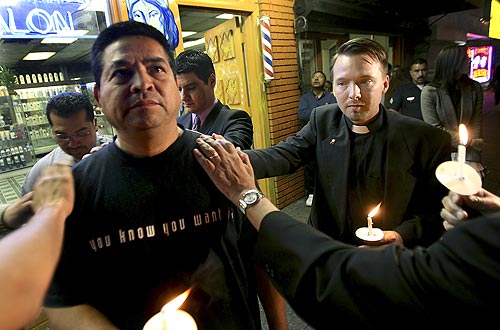
As a Presbyterian pastor with four years of urban ministry, I have walked with forty families who have lost loved ones to gang violence. Again and again, I saw families experience isolation and a lack of emotional and spiritual support. As Christians, we must confront the gang-banger-stigma that blames the victim for this tragedy. No mother or father should have to bear being stigmatized on top of their grief and loss.
This urban peacemaking ministry began several years ago when three young adults in our community in West Los Angeles were shot and killed in just three days. This was a baptism by fire into the peacemaking ministry our urban congregations are called to be engaged in. Gang violence has placed far too many families into the darkest valley of grief and loss. In the summer of 2006, Anna Interiano was on her way home from summer school at Hamilton High when she was gunned down in an alley, just blocks from Palms Westminster Presbyterian Church.
While trying to help raise money for the family, I joined family and friends for some pizza across the street from their residence. I was not comfortable with how the kids were exposing themselves to the risk for robbery with these shoe boxes filled with money. My fears were warranted, William Alavos and Julio Perez, two of the guys I had just broke bread with were killed thirty minutes after I left.
This second shooting took place as Mayor Villaraigosa was approaching the residence to offer condolences to Anna’s family. He and his staff were evacuated because the shooting was just a few blocks away. All three grieving families went into hiding. Three gang-related homicides in three days, just blocks apart! We opened the manse of the church to literally be sanctuary for the Interiano, Perez and Avalos families. Here in an undisclosed location they could meet with elected officials who wished to extend compassion to these families.
It just so happened this was the same day we were to baptize Baby Jordan whose aunt, Kim Canedy is now an elder at Palms Westminster. Her sister, Dana Canedy, and baby Jordan flew in from NY, where Dana is a Senior Editor for the New York Times. Ordinarily, we do not baptize children who can not be regular participants in the life of the church, but these were special circumstances. Jordan’s father, Charles, was serving in Iraq as a commissioned officer in the US Army. This was a pastoral moment for a family making great sacrifices on behalf of us all.
It was a delicate situation to explain to Dana that we would need to make some adjustments for the worship service when we would baptize her baby. Two of the grieving families would be joining us for worship, along with the Mayor and Councilman Wesson and Councilman Weiss. As we learned on 9-11, when tragedy befalls a community we need to keep the doors of our sanctuaries open.
There were many layers to this worship service, we also prayed for Charles’ safety as he served in Iraq. Tragedy upon tragedy, Charles never made it back from Iraq. We lost another life to violence when an I.E.D went off beneath Charles’ Humvee. While in Iraq, Charles kept a journal for his son. These words of wisdom from a father to his son were compiled by Dana Canedy into a book, A Journal for Jordan. We see this movement again and again, how God is at work bringing hope out of a tragedy. The movie rights have been sold and Denzel Washington will play Charles in an upcoming movie. Charles has been able to provide for his baby son long after he is gone.
In the book released last December, Dana writes about the Sunday we baptized Baby Jordan. This was a very dramatic Sunday. Several police cars blocked the streets leading to the church to ensure that there would not be a repeat of what happened just a few days earlier. The word on the street was that the suspects for these three murders were African American gang members. So here we are gathered at the baptismal font with an African American family and two grieving Latino families just a couple pews away. This baptismal moment has transformed our understanding of what these sacramental waters truly mean. In these waters we are reconciled to Christ and to one another as one body.
After I baptized baby Jordan, Dana graciously placed him in the hands of the grieving Interiano and Perez families. Anna’s older brother, Christian, held Jordan as if this was the most fragile and precious gift from God. Christian, an angry young man, who had just been released from custody for smashing a police car windshield and resisting arrest is now holding our new brother in Christ with a sense of peace and reconciliation.
We have many Presbyterian churches in our urban centers where gang violence continues to traumatize the community. My hope and prayer is that more of our Presbyterian pastors and congregations will open their hearts and minds to this peacemaking ministry that is on their door step. We are called to walk with our brothers and sisters through these dark valleys of grief and despair. They need to know that God is with them. They need to understand that this tragedy says more about who we are as a society, rather than who God is or what God’s plan are. May these grieving families find a glimmer hope emerging from the tragedy. May our congregations embrace them in their wilderness journey, and together find ways to create meaning through our ministry of peace and reconciliation.
Rev. Howard Dotson
Founder and Director, Urban Peacemakers
Non profit agency in St Paul, MN that facilitates crisis intervention and gang intervention services in the Twin Cities Metro
Rev. Howard Dotson
When our seminarians leave the ivory tower, many are ill prepared to confront the violence and despair so prevalent in our urban communities. Gang violence is an epidemic in cities across America. In our pastoral care and counseling courses, we do not receive adequate preparation to walk with the crime victim families after a violent tragedy.
As a Presbyterian pastor with four years of urban ministry, I have walked with forty families who have lost loved ones to gang violence. Again and again, I saw families experience isolation and a lack of emotional and spiritual support. As Christians, we must confront the gang-banger-stigma that blames the victim for this tragedy. No mother or father should have to bear being stigmatized on top of their grief and loss.
This urban peacemaking ministry began several years ago when three young adults in our community in West Los Angeles were shot and killed in just three days. This was a baptism by fire into the peacemaking ministry our urban congregations are called to be engaged in. Gang violence has placed far too many families into the darkest valley of grief and loss. In the summer of 2006, Anna Interiano was on her way home from summer school at Hamilton High when she was gunned down in an alley, just blocks from Palms Westminster Presbyterian Church.
While trying to help raise money for the family, I joined family and friends for some pizza across the street from their residence. I was not comfortable with how the kids were exposing themselves to the risk for robbery with these shoe boxes filled with money. My fears were warranted, William Alavos and Julio Perez, two of the guys I had just broke bread with were killed thirty minutes after I left.
This second shooting took place as Mayor Villaraigosa was approaching the residence to offer condolences to Anna’s family. He and his staff were evacuated because the shooting was just a few blocks away. All three grieving families went into hiding. Three gang-related homicides in three days, just blocks apart! We opened the manse of the church to literally be sanctuary for the Interiano, Perez and Avalos families. Here in an undisclosed location they could meet with elected officials who wished to extend compassion to these families.
It just so happened this was the same day we were to baptize Baby Jordan whose aunt, Kim Canedy is now an elder at Palms Westminster. Her sister, Dana Canedy, and baby Jordan flew in from NY, where Dana is a Senior Editor for the New York Times. Ordinarily, we do not baptize children who can not be regular participants in the life of the church, but these were special circumstances. Jordan’s father, Charles, was serving in Iraq as a commissioned officer in the US Army. This was a pastoral moment for a family making great sacrifices on behalf of us all.
It was a delicate situation to explain to Dana that we would need to make some adjustments for the worship service when we would baptize her baby. Two of the grieving families would be joining us for worship, along with the Mayor and Councilman Wesson and Councilman Weiss. As we learned on 9-11, when tragedy befalls a community we need to keep the doors of our sanctuaries open.
There were many layers to this worship service, we also prayed for Charles’ safety as he served in Iraq. Tragedy upon tragedy, Charles never made it back from Iraq. We lost another life to violence when an I.E.D went off beneath Charles’ Humvee. While in Iraq, Charles kept a journal for his son. These words of wisdom from a father to his son were compiled by Dana Canedy into a book, A Journal for Jordan. We see this movement again and again, how God is at work bringing hope out of a tragedy. The movie rights have been sold and Denzel Washington will play Charles in an upcoming movie. Charles has been able to provide for his baby son long after he is gone.
In the book released last December, Dana writes about the Sunday we baptized Baby Jordan. This was a very dramatic Sunday. Several police cars blocked the streets leading to the church to ensure that there would not be a repeat of what happened just a few days earlier. The word on the street was that the suspects for these three murders were African American gang members. So here we are gathered at the baptismal font with an African American family and two grieving Latino families just a couple pews away. This baptismal moment has transformed our understanding of what these sacramental waters truly mean. In these waters we are reconciled to Christ and to one another as one body.
After I baptized baby Jordan, Dana graciously placed him in the hands of the grieving Interiano and Perez families. Anna’s older brother, Christian, held Jordan as if this was the most fragile and precious gift from God. Christian, an angry young man, who had just been released from custody for smashing a police car windshield and resisting arrest is now holding our new brother in Christ with a sense of peace and reconciliation.
We have many Presbyterian churches in our urban centers where gang violence continues to traumatize the community. My hope and prayer is that more of our Presbyterian pastors and congregations will open their hearts and minds to this peacemaking ministry that is on their door step. We are called to walk with our brothers and sisters through these dark valleys of grief and despair. They need to know that God is with them. They need to understand that this tragedy says more about who we are as a society, rather than who God is or what God’s plan are. May these grieving families find a glimmer hope emerging from the tragedy. May our congregations embrace them in their wilderness journey, and together find ways to create meaning through our ministry of peace and reconciliation.
Rev. Howard Dotson
Founder and Director, Urban Peacemakers
Non profit agency in St Paul, MN that facilitates crisis intervention and gang intervention services in the Twin Cities Metro
Saturday, March 21, 2009
Journal for Jordan
Dear Friends:
You may recall that tragic summer when we lost three young adults in three days in West LA.
Many of you were there when Baby Jordan was baptized at Palms Westminster.
Jordan's Mom, Dana Canedy has written a book about Jordan's father, Charles, who wrote a journal for his son while he served in Iraq.
Charles was killed by an IED in Iraq just a few months after we baptized his son.
In the book, A Journal for Jordan, pp 161-165, Dana reflects on the baptism and the ministry of reconciliation that took place that Sunday.
Indeed, Baby Jordan was a blessing to Anna and Julio's family in the midst of their grief.
Let us pray that the baptismal font continues to bring peace, healing and reconciliation for our brothers and sisters in Los Angeles and around the world.
You may recall that tragic summer when we lost three young adults in three days in West LA.
Many of you were there when Baby Jordan was baptized at Palms Westminster.
Jordan's Mom, Dana Canedy has written a book about Jordan's father, Charles, who wrote a journal for his son while he served in Iraq.
Charles was killed by an IED in Iraq just a few months after we baptized his son.
In the book, A Journal for Jordan, pp 161-165, Dana reflects on the baptism and the ministry of reconciliation that took place that Sunday.
Indeed, Baby Jordan was a blessing to Anna and Julio's family in the midst of their grief.
Let us pray that the baptismal font continues to bring peace, healing and reconciliation for our brothers and sisters in Los Angeles and around the world.
Saturday, March 14, 2009
Jesus Cleanin' House
Jesus Cleanin’ House March 15, 2008
John 2:13-25
The Passover of the Jews was near, and Jesus went up to Jerusalem. In the temple he found people selling cattle, sheep, and doves, and the money changers seated at their tables. Making a whip of cords, he drove all of them out of the temple, both the sheep and the cattle. He also poured out the coins of the money changers and overturned their tables. He told those who were selling the doves, “Take these things out of here! Stop making my Father’s house a marketplace!” His disciples remembered that it was written, “Zeal for your house will consume me.” The Jews then said to him, “What sign can you show us for doing this?” Jesus answered them, “Destroy this temple, and in three days I will raise it up.” The Jews then said, “This temple has been under construction for forty-six years, and will you raise it up in three days?” But he was speaking of the temple of his body. After he was raised from the dead, his disciples remembered that he had said this; and they believed the scripture and the word that Jesus had spoken. When he was in Jerusalem during the Passover festival, many believed in his name because they saw the signs that he was doing. But Jesus on his part would not entrust himself to them, because he knew all people and needed no one to testify about anyone; for he himself knew what was in everyone.
In our Gospel lesson today we take a break from Mark’s gospel. The next several weeks we will reflect on the passion story in John. This is a powerful image of Jesus cleaning house. It runs contrary to the Jesus is my boyfriend mindset that tends to go around. Yes, there is a time and place for righteous anger. This is where Jesus finds himself at the Temple on the eve of Passover.
I like to think of on old Western movie when there is a showdown at high noon. John Wayne or Clint Eastwood is portraying Jesus. They are having a showdown with the powers that be, because the town bullies have pushed the towns people around long enough. It takes a hero from the outside to come into to town to confront this oppressive situation.
Have you ever been in crowd where you feel you hardly have room to breathe, let alone adjust your elbow? That is what Jerusalem was like during Passover. Thousands of people throughout the country side have come into Jerusalem to offer their animal sacrifice at the Temple.
So what is Jesus so ticked off about? Well for starters the temple authorities have moved the money changing tables from the traditional site the Mount of Olives to the Gentile Court in the Temple. There are corrupt temple authorities placating the Roman occupiers, and allowing price gouging and unfair currency exchanges to take place. When a faithful Jewish came into the Temple they were not allowed to carry anything with a graven image. These poor peasants from the countryside, trying to be faithful Jews, only had the Roman currency. In order for them to purchase the doves and other animals for sacrifice, first, they had to exchange their coins with the Images of Caesar on them into the local currency in Jerusalem. King Herod was smart enough not to mint coins that set off the revolutionary masses who would not tolerate a graven image in the Temple.
Jesus sees how the powers that be are exploiting a situation and profiting on the backs of people trying to be faithful observers of Judaism. This is what set him off. Why should the faithful have to go the Gentile Court to be price goughed? This is how the authorities have turned to the house of prayer into the den of thieves.
So what’s going on today that would be an equivalent? The NAACP just brought a law suit against several banks and lenders who are charged with unfair lending practices. They directed African American with the same credit history and lending status as Euro American into sub-prime loans. The temple authorities of our day are some dishonest bankers and lenders. This has been a concern for decades, yet we seem to have not made much progress. There is a time for righteous anger, when we see that the people who wield power do not seem to be held accountable. Jesus stands in the long line of the prophets of old who remembered the least among us and gave them a voice and sense of agency.
Another example comes to us from Cameroon. Sally shared this article with me from the Reuter Press. The Roman Catholic Pope, Benedict, is due to visit Africa to partake in the celebrations of the 500th anniversary of the church in Africa. The security forces in Yaoundé forcibly demolished the street vendor kiosks to give the city a face lift for the Papal visit. The powers that be need to hear this story again from John’s gospel. Jesus was angry because he heard the cries of the poor and oppressed. The blinders of idolatry have again eclipsed a people’s vision of where Jesus dwells. Jesus sees and hears the plight of these streets vendors whose livelihood has been taken from them for the sake of appearances.
Those in power need to remember where God’s ultimate allegiance rests. We will always have some modern day temple and religious authorities with us. They get so caught up in the game they loose sight of what really matters. Every child of God is entitled to their access to daily bread. The authorities in Yaoundé should have explored alternative ways of using the vendors to sell all the tourist trinkets that come with a Papal visit. We all know the tourist trap and the memorabilia that is sold. Instead, the powers that be thought God’s was on their side when they pushed aside our brothers and sisters doing their best to put bread on their tables for their families.
The Judeans had a hard time understanding Jesus’ teaching and the sign he presents to them. Destroy this temple and you will raise it again in three days? The Jewish people had no idea what was on the horizon when Jesus cleansed the temple. They did not know that Nero would torch the place in 70 AD. The audience in John’s audience, however, understood what this cleansing of the temple meant, because the gospel was written a good twenty to thirty years after the Jewish temple was no longer in existence.
Jesus is trying to explain to the crowds that the temple will be destroyed and recreated through the death and resurrection of the Messiah. John’s gospel is filled with various signs and symbols that help explain Jesus life and ministry. Do you remember the first miracle in John? Jesus turns water into wine at the wedding in Cana. Now we are approaching the Passover, when the cup of Elijah is lifted up and the Jewish people remember God’ s promise to send a Messiah who will complete their exodus from Egypt long ago.
It’s interesting that in John’s gospel the cleansing of the temple comes at the beginning of the Gospel, where in Matthew, Mark and Luke this showdown comes at the very end. This is the cataclysmic event that gets Jesus arrested and tried for treason. Several scholars have questioned whether it’s accurate to place this event at the beginning of Jesus ministry.
What many people don’t realize is that every year at Passover, false prophets would ride in on a donkey, and proclaim to be the messiah that has come to deliver the Jews from occupation. And every year, the Roman centurions would arrest these people and they would be executed for treason. Jesus knows the cross he is picking up when he gets on that colt and donkey makes the fateful procession on Psalm Sunday.
For too long, Christians have pinned the blame on the Jews for Jesus’ death. We all as a collective humanity put Jesus on the Cross. If Jesus was to come back today, there are powerful people in this world who want to put him back on the Cross again. As Christians, we need to take an ongoing self-inventory lest we continue the anti-Semitism that comes from a literal reading of the passion story. Mel Gibbon’s Passion is not adequate source material to understand the historical and sociological reality of Jesus time.
The Good News is that the Temple has been restored through the death and resurrection of our Risen Lord. The body of Christ is the new temple that transcends time and space. No more animal sacrifices are required for us to have access to God. We do not need any intermediaries between us and God. We open God’s word, commune in the Spirit and we are in the standing in the temple which is the Body of Christ. Each of us carries the presence of God’ s Spirit into our communities.
In our Gospel lesson today, Jesus has modeled for us how there is a time and place for righteous anger. When we see the poor and vulnerable being exploited by the money changers of our day, we too should flip some tables and clear away the den of thieves. Our thoughts and prayers go out to the millions of unemployed today because of the money changers in Wall Street.
May the fires of God’s justice burn and a brighter day dawn. Jesus is still cleaning house and we are the brooms and mops. We keep our ears, eyes and hearts open to know where God is calling us to be. We too carry a cross of love and make sacrifices on behalf of our brothers and sisters on the margins. Never again will God’s temple be made den of thieves.
Gracious God, cleanse our hearts and minds so we can serve as pure vessels in your new temple the Body of Christ. Send us out from here to flip any table that keeps our brothers and sisters from having access to their daily bread. May your manna from heaven fall among us. We may not carry whips but we seek the sword of your Spirit. May hardened hearts be shattered into hearts of compassion. May we see and hear where you are calling us to go, and express the righteousness anger you shared long ago. We want to dwell in your holy temple all the days of our lives.
John 2:13-25
The Passover of the Jews was near, and Jesus went up to Jerusalem. In the temple he found people selling cattle, sheep, and doves, and the money changers seated at their tables. Making a whip of cords, he drove all of them out of the temple, both the sheep and the cattle. He also poured out the coins of the money changers and overturned their tables. He told those who were selling the doves, “Take these things out of here! Stop making my Father’s house a marketplace!” His disciples remembered that it was written, “Zeal for your house will consume me.” The Jews then said to him, “What sign can you show us for doing this?” Jesus answered them, “Destroy this temple, and in three days I will raise it up.” The Jews then said, “This temple has been under construction for forty-six years, and will you raise it up in three days?” But he was speaking of the temple of his body. After he was raised from the dead, his disciples remembered that he had said this; and they believed the scripture and the word that Jesus had spoken. When he was in Jerusalem during the Passover festival, many believed in his name because they saw the signs that he was doing. But Jesus on his part would not entrust himself to them, because he knew all people and needed no one to testify about anyone; for he himself knew what was in everyone.
In our Gospel lesson today we take a break from Mark’s gospel. The next several weeks we will reflect on the passion story in John. This is a powerful image of Jesus cleaning house. It runs contrary to the Jesus is my boyfriend mindset that tends to go around. Yes, there is a time and place for righteous anger. This is where Jesus finds himself at the Temple on the eve of Passover.
I like to think of on old Western movie when there is a showdown at high noon. John Wayne or Clint Eastwood is portraying Jesus. They are having a showdown with the powers that be, because the town bullies have pushed the towns people around long enough. It takes a hero from the outside to come into to town to confront this oppressive situation.
Have you ever been in crowd where you feel you hardly have room to breathe, let alone adjust your elbow? That is what Jerusalem was like during Passover. Thousands of people throughout the country side have come into Jerusalem to offer their animal sacrifice at the Temple.
So what is Jesus so ticked off about? Well for starters the temple authorities have moved the money changing tables from the traditional site the Mount of Olives to the Gentile Court in the Temple. There are corrupt temple authorities placating the Roman occupiers, and allowing price gouging and unfair currency exchanges to take place. When a faithful Jewish came into the Temple they were not allowed to carry anything with a graven image. These poor peasants from the countryside, trying to be faithful Jews, only had the Roman currency. In order for them to purchase the doves and other animals for sacrifice, first, they had to exchange their coins with the Images of Caesar on them into the local currency in Jerusalem. King Herod was smart enough not to mint coins that set off the revolutionary masses who would not tolerate a graven image in the Temple.
Jesus sees how the powers that be are exploiting a situation and profiting on the backs of people trying to be faithful observers of Judaism. This is what set him off. Why should the faithful have to go the Gentile Court to be price goughed? This is how the authorities have turned to the house of prayer into the den of thieves.
So what’s going on today that would be an equivalent? The NAACP just brought a law suit against several banks and lenders who are charged with unfair lending practices. They directed African American with the same credit history and lending status as Euro American into sub-prime loans. The temple authorities of our day are some dishonest bankers and lenders. This has been a concern for decades, yet we seem to have not made much progress. There is a time for righteous anger, when we see that the people who wield power do not seem to be held accountable. Jesus stands in the long line of the prophets of old who remembered the least among us and gave them a voice and sense of agency.
Another example comes to us from Cameroon. Sally shared this article with me from the Reuter Press. The Roman Catholic Pope, Benedict, is due to visit Africa to partake in the celebrations of the 500th anniversary of the church in Africa. The security forces in Yaoundé forcibly demolished the street vendor kiosks to give the city a face lift for the Papal visit. The powers that be need to hear this story again from John’s gospel. Jesus was angry because he heard the cries of the poor and oppressed. The blinders of idolatry have again eclipsed a people’s vision of where Jesus dwells. Jesus sees and hears the plight of these streets vendors whose livelihood has been taken from them for the sake of appearances.
Those in power need to remember where God’s ultimate allegiance rests. We will always have some modern day temple and religious authorities with us. They get so caught up in the game they loose sight of what really matters. Every child of God is entitled to their access to daily bread. The authorities in Yaoundé should have explored alternative ways of using the vendors to sell all the tourist trinkets that come with a Papal visit. We all know the tourist trap and the memorabilia that is sold. Instead, the powers that be thought God’s was on their side when they pushed aside our brothers and sisters doing their best to put bread on their tables for their families.
The Judeans had a hard time understanding Jesus’ teaching and the sign he presents to them. Destroy this temple and you will raise it again in three days? The Jewish people had no idea what was on the horizon when Jesus cleansed the temple. They did not know that Nero would torch the place in 70 AD. The audience in John’s audience, however, understood what this cleansing of the temple meant, because the gospel was written a good twenty to thirty years after the Jewish temple was no longer in existence.
Jesus is trying to explain to the crowds that the temple will be destroyed and recreated through the death and resurrection of the Messiah. John’s gospel is filled with various signs and symbols that help explain Jesus life and ministry. Do you remember the first miracle in John? Jesus turns water into wine at the wedding in Cana. Now we are approaching the Passover, when the cup of Elijah is lifted up and the Jewish people remember God’ s promise to send a Messiah who will complete their exodus from Egypt long ago.
It’s interesting that in John’s gospel the cleansing of the temple comes at the beginning of the Gospel, where in Matthew, Mark and Luke this showdown comes at the very end. This is the cataclysmic event that gets Jesus arrested and tried for treason. Several scholars have questioned whether it’s accurate to place this event at the beginning of Jesus ministry.
What many people don’t realize is that every year at Passover, false prophets would ride in on a donkey, and proclaim to be the messiah that has come to deliver the Jews from occupation. And every year, the Roman centurions would arrest these people and they would be executed for treason. Jesus knows the cross he is picking up when he gets on that colt and donkey makes the fateful procession on Psalm Sunday.
For too long, Christians have pinned the blame on the Jews for Jesus’ death. We all as a collective humanity put Jesus on the Cross. If Jesus was to come back today, there are powerful people in this world who want to put him back on the Cross again. As Christians, we need to take an ongoing self-inventory lest we continue the anti-Semitism that comes from a literal reading of the passion story. Mel Gibbon’s Passion is not adequate source material to understand the historical and sociological reality of Jesus time.
The Good News is that the Temple has been restored through the death and resurrection of our Risen Lord. The body of Christ is the new temple that transcends time and space. No more animal sacrifices are required for us to have access to God. We do not need any intermediaries between us and God. We open God’s word, commune in the Spirit and we are in the standing in the temple which is the Body of Christ. Each of us carries the presence of God’ s Spirit into our communities.
In our Gospel lesson today, Jesus has modeled for us how there is a time and place for righteous anger. When we see the poor and vulnerable being exploited by the money changers of our day, we too should flip some tables and clear away the den of thieves. Our thoughts and prayers go out to the millions of unemployed today because of the money changers in Wall Street.
May the fires of God’s justice burn and a brighter day dawn. Jesus is still cleaning house and we are the brooms and mops. We keep our ears, eyes and hearts open to know where God is calling us to be. We too carry a cross of love and make sacrifices on behalf of our brothers and sisters on the margins. Never again will God’s temple be made den of thieves.
Gracious God, cleanse our hearts and minds so we can serve as pure vessels in your new temple the Body of Christ. Send us out from here to flip any table that keeps our brothers and sisters from having access to their daily bread. May your manna from heaven fall among us. We may not carry whips but we seek the sword of your Spirit. May hardened hearts be shattered into hearts of compassion. May we see and hear where you are calling us to go, and express the righteousness anger you shared long ago. We want to dwell in your holy temple all the days of our lives.
Subscribe to:
Posts (Atom)

 Posts
Posts